Evolution of the Smartphone Timeline: From the IBM Simon (1994) to the iPhone Duo (2026)
By Chester Takau · November 2026
The evolution of the smartphone timeline runs through four turning points: the IBM Simon, which went on sale in 1994 after a 1992 prototype; the Treo and BlackBerry years; the original iPhone in 2007; and the foldables of 2026, including Apple's first, the $1,999 iPhone Duo. Which phone counts as "first" depends on the definition you use, and the table below sets the criteria side by side. The 2026 chapter has a twist the older timelines lack: global shipments are falling sharply while memory costs push prices up.
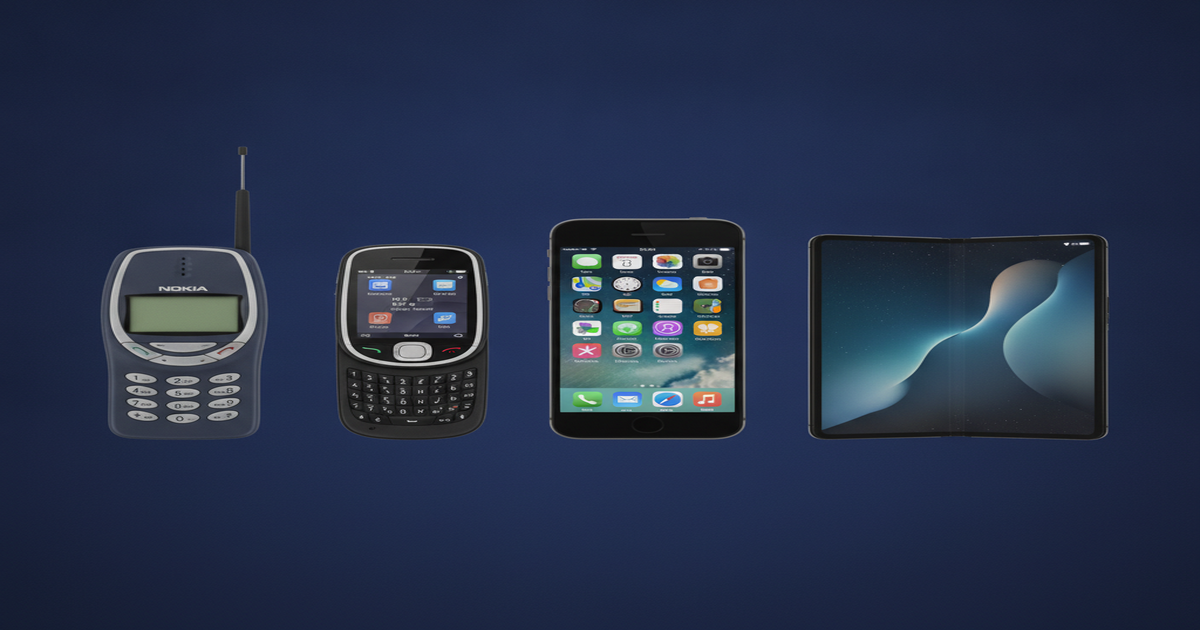
What was the first smartphone?
Three answers circulate: the IBM Simon (a 1992 prototype, sold from 1994), the Nokia Communicator, and the iPhone in 2007. Some people argue for the Handspring and Palm Treo as the first "real" smartphone, and The Verge made a documentary on that case. LG once published a smartphone timeline that left out the iPhone entirely and was ridiculed for it, per BGR. The sources disagree because they weigh different features. The table shows how the verdict changes with the test.
| Criterion | Best claim | Why |
|---|---|---|
| Earliest phone plus computing | IBM Simon (1992 prototype, 1994 sale) | First to combine a phone with organiser-style software in one device |
| Full keyboard and data on a phone | Nokia Communicator / BlackBerry | Built for messaging and email, aimed at business users |
| "First real smartphone" | Handspring / Palm Treo | The argument made in The Verge's documentary; a phone and handheld that people actually carried |
| Mass-market touchscreen era | iPhone (2007) | The design that most later phones copied |
My reading: "first" is a fair label for the Simon, "first one people wanted" fits the Treo, and "the one that set the template" belongs to the iPhone. A reader who wants the broader backdrop, where the phone sits among earlier gadgets that tried to be the centre of a person's tech, can follow the history of consumer tech hub from the hi-fi stack to the iPod to the phone.
Why did BlackBerry and Palm lose so fast?
Forum threads from the time show how contested the iPhone's launch was. A MacRumors thread asked what Treo fans thought of it, and many pointed to what it lacked: no MMS, no 3G and no apps. BlackBerry forums were making similar comparisons. The iPhone's touchscreen, browser and later its app store made those gaps look small within a few years. I have not found a source that gives one clean cause for the collapse of the older platforms, so treat any single-reason explanation with caution.
Did smartphone cameras really stop improving?
This is the 2020s version of the "have phones peaked?" argument. Marques Brownlee took it on in "Why New Smartphone Cameras Feel Worse" (May 11, 2026), comparing output across iPhone generations. He starts with how little the first camera mattered:
"Of course, when it first started, the first iPhone camera was almost an afterthought."
His argument is that the dramatic improvements were getting less dramatic. Commenters put it more bluntly: the picture quality is "basically all the same after iPhone 4S." A viral same-photo comparison across iPhone models fed that reaction. TechRadar readers voted that modern phones "all look the same," while TechRadar's own view is that the gains are real but less visible. Brownlee's April 2026 video "So This is Peak Smartphone" looks at a maxed-out Android flagship with a 7,050mAh battery and two 200MP cameras as the endpoint of the slab phone. The numbers kept rising. The experience of each jump got smaller.
When did foldables become the next chapter?
Samsung started the category with the Galaxy Fold in 2019. At Galaxy Unpacked on July 22, 2026 it announced the Galaxy Z Fold8 Ultra, the Z Fold8, a wider "passport-style" foldable, and the Z Flip8. Samsung's official launch post is dated August 6, so you will see both dates in coverage.
Apple answered on September 9, 2026 at its "Surprise and Shine" event with the iPhone Duo, not "iPhone Fold" as the rumours said. It has a 7.6" inner display, a 5.4" outer display, the A20 Pro chip, a grade 5 titanium body, IP68 and iOS 27. It starts at $1,999, was John Ternus's first launch as Apple CEO, opened for pre-order on October 16 and reached stores worldwide on October 23. Coverage calls it the biggest change to the iPhone since 2007. Benzinga noted it arrives about eight Samsung foldable generations later.
Reviews were mixed. Reviewers praised the nearly hidden crease and the nano-texture display. They criticised the price (about $800 above the 18 Pro), the missing telephoto lens and the weight, reported as 25% or more heavier than the Z Fold8. Notebookcheck's test found the crease deepens after 500 folds. Whether foldables are the next big era or a niche is still an open question, and one launch does not settle it. Tom's Guide's roundup of the flaws nine reviewers found in the iPhone Duo is a good place to compare them.
Why are phones getting more expensive in 2026?
AI data centres are absorbing memory supply. Counterpoint's analysis reports DRAM prices up about 50% and NAND up to 90% in Q1 2026, and it forecast smartphone average selling prices up about 6.9% for 2026. Some brands are cutting RAM and storage at the same price instead of raising it.
Shipments reflect it. Preliminary Q3 2026 data from Counterpoint shows global shipments down 20% year over year, the lowest Q3 since 2012. IDC's preliminary figure is a 22% fall to 255.3 million units, which it calls its largest quarterly decline on record. Samsung shipped 57.8 million (22.6%) and Apple 57.3 million (22.4%). Both firms blame memory costs. These are early estimates and may be revised.
The timeline at a glance
| Year | Milestone |
|---|---|
| 1992 / 1994 | IBM Simon prototype, then on sale |
| Early 2000s | Communicator, BlackBerry and Treo era |
| 2007 | Original iPhone |
| 2019 | Samsung Galaxy Fold |
| Jul 2026 | Galaxy Z Fold8 Ultra, Fold8 and Flip8 |
| Sep–Oct 2026 | iPhone Duo announced (Sep 9), in stores Oct 23 |
| Q3 2026 | Shipments fall 20–22% year over year (preliminary) |
The original iPhone's 20th anniversary comes in January 2027. If the 2026 data holds, the next chapter may be written less by new features than by who can afford the memory to build them.
Sources
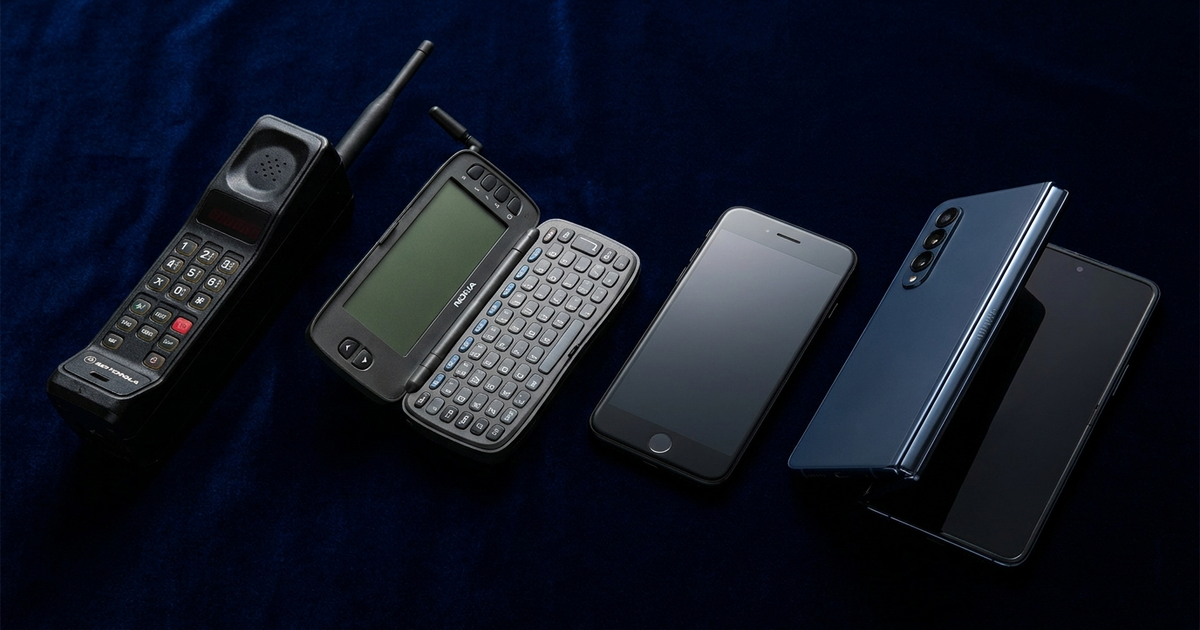
- TechRadar — A brief history of the smartphone
- Apple Newsroom — iPhone Duo, September 2026
- Samsung Newsroom — Galaxy Unpacked, July 2026
- Fone Arena — Counterpoint Q3 2026 shipments
- TechEnclave — IDC Q3 2026 estimate
- Counterpoint — AI-fuelled chip shortage and smartphone prices
- Tom's Guide — iPhone Duo review consensus
- Notebookcheck — iPhone Duo crease test
- BGR — LG smartphone evolution infographic
- Marques Brownlee — Why New Smartphone Cameras Feel Worse
- Marques Brownlee — So This is Peak Smartphone
- The Verge — Springboard: the secret history of the first real smartphone
Updated November 2026.
Transparency note: This article was researched and written by Chester Takau with AI assistance for research gathering and drafting. All recommendations reflect the author's own editorial judgment.