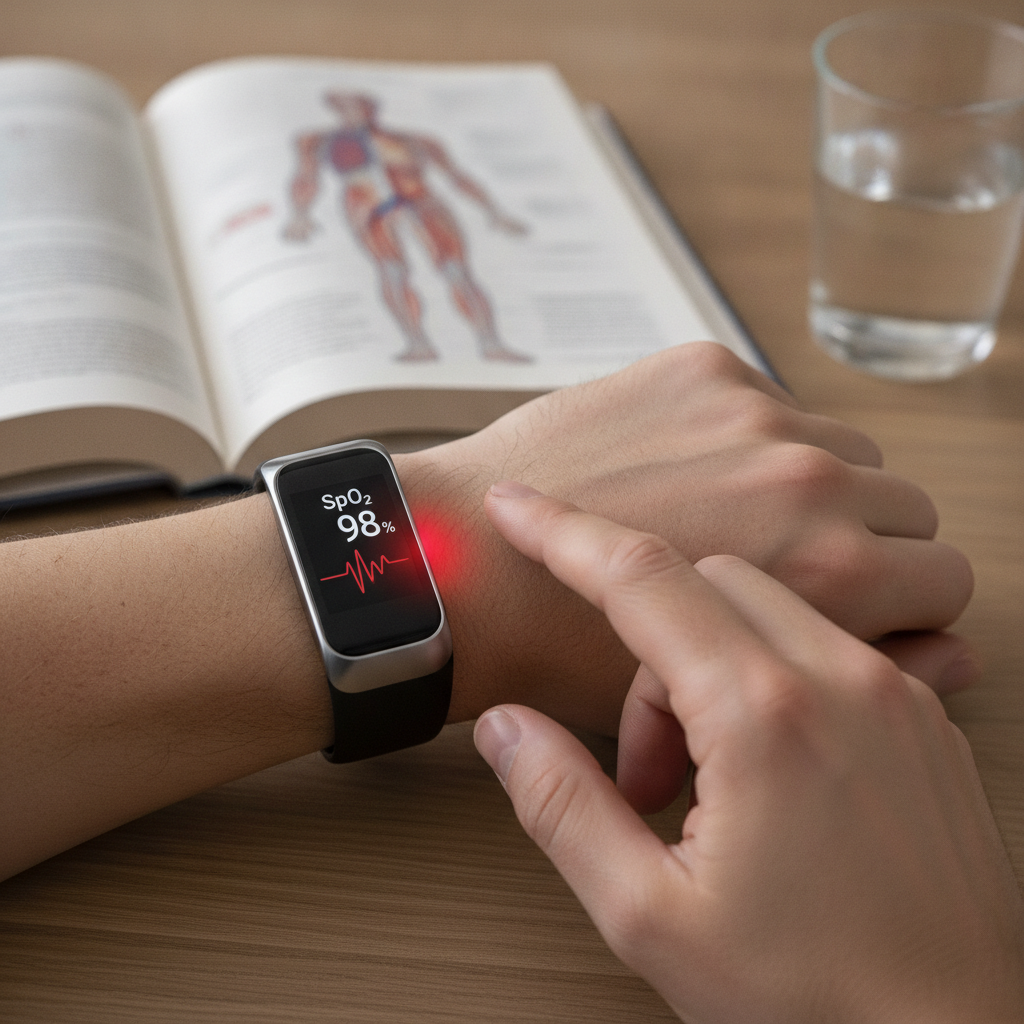
Every blood-oxygen wearable on the market does the same basic trick: it shines red and infrared light into your skin, measures how much comes back, and estimates SpO2 — the percentage of your hemoglobin currently carrying oxygen. That number is a useful trend gauge and a genuinely rough medical measurement at the same time. These sensors are most reliable when you're sitting still with normal oxygen levels, and least reliable in exactly the situations where you'd want a warning: during movement, and when SpO2 drops below 90%.
That gap between marketing and physics matters more in 2026 than it used to. Apple spent roughly two years locked out of its own Blood Oxygen feature because of a patent dispute, then restored it in August 2025 through a workaround that moves the calculation off the watch and onto your iPhone. An FDA-commissioned study on pulse oximeters' racial accuracy gap, reported in January 2026, came back inconclusive. And in June 2026, a continuous ear-worn oximeter called OxiWear gained Medicare coverage — a sign that wearable SpO2 is splitting into two categories: wellness gadget and reimbursable medical device. This guide covers what the sensors actually measure, what the numbers mean, and when a reading is worth acting on. Nothing here is medical advice; if a reading worries you, the right response is a proper fingertip oximeter and a call to your doctor.
How do blood oxygen sensors in wearables actually work?
All pulse oximetry relies on one fact of biology: hemoglobin carrying oxygen absorbs red and infrared light differently than hemoglobin without oxygen. Shine both wavelengths through blood-perfused tissue, measure the ratio of absorption, and you can estimate saturation. A healthy reading at sea level typically sits between 95% and 100%.
Where devices differ is the light path. A drugstore fingertip oximeter is transmissive: the emitter sits on one side of your finger and the detector on the other, reading light that has passed clean through. Watches and rings are reflective: emitter and detector sit side by side on the same surface, catching whatever light scatters back. The reflective approach works anywhere on the body, which is why it fits in a watch back — but the return signal is weaker and far easier to corrupt.
The wrist is a particularly hard place to do this. It has bones and tendons close to the surface, less dense capillary beds than a fingertip, and it moves constantly. Motion floods the photoplethysmography (PPG) signal with noise, which is why watch algorithms quietly discard bad measurement windows — and why your overnight SpO2 graph has gaps in it. Wareable's pulse oximeter explainer walks through how Fitbit, Garmin and others each handle this filtering.
Is my smartwatch's blood oxygen reading actually accurate, or just a rough estimate?
Both, depending on the conditions. At rest, in the normal 95–100% range, leading wearables generally land within a couple of points of a fingertip oximeter — close enough to be a sensible trend gauge. The manufacturers know the limits better than their ads suggest. Garmin states outright that its Pulse Ox feature is not intended for medical purposes, and Apple frames its feature the same way, a tension TechRadar's accuracy write-up calls out directly: heavy health marketing wrapped around a wellness disclaimer.
Why accuracy falls apart below 90%
Two reasons. Calibration data comes mostly from healthy volunteers, and ethics boards understandably limit how low researchers can deliberately drop a subject's oxygen — so algorithms are trained thickest in the normal range and thinnest in the dangerous one. On top of that, the optical signal-to-noise ratio degrades as saturation falls. The practical result, noted across multiple studies: wrist wearables are least trustworthy exactly below 90% SpO2. A watch showing 88% might really be 92% or 84%. Treat any sub-90 reading as a prompt to verify with a fingertip device, not as a verdict.
Does skin tone or tattoo placement affect the sensor?
Yes, and this is the most serious open problem in the field. Melanin absorbs light, so darker skin returns a weaker optical signal. Decades of studies — more than half of them published since 2020, per Johns Hopkins' summary and a Health Affairs analysis — show conventional pulse oximeters overestimate SpO2 in darker-skinned patients at low saturations, which can mask real hypoxemia.
The fix has stalled. STAT News reported on January 12, 2026 that an FDA-commissioned study on the problem returned inconclusive, non-peer-reviewed results, leaving clinicians without updated guidance. Then a Stanford follow-up in May 2026 tied the bias to outcomes: overestimated readings were directly linked to reduced follow-up care for Black patients compared with white patients showing identical numbers.
The same physics applies to consumer wearables, with one interesting exception. A validation study of a smart ring oximeter found near-zero skin-tone bias — 0.0% for Black participants versus −0.7% for others — because the palmar side of the finger carries less pigment and interferes less with the light path. Tattoos are a simpler problem: dark ink directly under the sensor absorbs the light and degrades or blocks readings, so wear the device on untattooed skin.
Why doesn't my Apple Watch show Blood Oxygen on the watch anymore?
Because of a patent fight, not a hardware fault. Medical-device company Masimo accused Apple of infringing its pulse oximetry patents, and the US International Trade Commission agreed, forcing Apple to sell Series 9 and Ultra 2 watches in the US with the Blood Oxygen feature disabled from early 2024.
On August 14, 2025, Apple restored the feature through a clever workaround, announced in Apple's Newsroom statement and covered by CNN: the watch sensor still captures the raw optical data, but the SpO2 calculation now happens on the paired iPhone, and results appear in the Health app's Respiratory section rather than on the watch face. It applies to Series 9, Series 10 and Ultra 2 units sold in the US. So if your readings seem to have "moved" to your phone, that is the design, not a bug. Since the iPhone now does the computing, it helps if yours is reasonably current — see our tested ranking of 2026's best smartphones if an upgrade is due.
The saga formally ended on April 17, 2026, when the ITC closed the case and declined further review, cementing Apple's right to sell its redesigned sensor in the US, as iDropNews reported on the final ruling. Most consumer coverage still describes the feature as simply "back" — the on-watch display is not, and that distinction trips up a lot of owners.
Which wearable is most accurate for SpO2 — watch, ring, or fingertip clip?
Different form factors win at different jobs. This table sums up where each stands as of mid-2026:
| Device type | How it measures | Where it performs best | Known limits |
|---|---|---|---|
| Fingertip pulse oximeter (drugstore clip, roughly $20–$30) | Transmissive: red/IR light passes through the finger to a detector on the other side | Spot checks; still the reference point wearables get compared against | Documented overestimation bias on darker skin at low saturations; no continuous trends |
| Apple Watch Series 9/10/Ultra 2 (US models) | Reflective PPG at the wrist; since August 2025, raw data captured on-watch and calculated on the paired iPhone | Background and on-demand readings folded into the Health app's Respiratory section | Results no longer shown on the watch itself in the US; wellness framing, wrist accuracy limits |
| Garmin watches (Venu 4, Elevate Gen 5 sensor) | Reflective PPG; the Gen 5 sensor pairs SpO2 with ECG, skin temperature and respiration | Overnight trends and altitude-acclimation metrics for hikers and athletes | Garmin explicitly disclaims medical use; same wrist-based noise problems |
| Smart rings (Oura, Wellue O2 Ring) | Reflective PPG on the palmar side of the finger, where pigment interference is lower | Continuous overnight SpO2; one validation study reported near-zero skin-tone bias | Oura produced anomalous low-SpO2 drops in Wareable's testing; still a wellness device |
| OxiWear ear-worn oximeter | Continuous medical pulse oximetry at the ear | FDA-cleared continuous monitoring; Medicare and participating-insurer coverage since June 2026 | A medical device with a prescription/coverage pathway, not a consumer gadget |
A few patterns stand out. For overnight continuous tracking, rings have a genuine physics advantage: the finger is better perfused than the wrist, and the palmar side sidesteps some of the pigment problem. That said, Wareable's smart ring testing logged unnatural drops into low-SpO2 ranges on Oura specifically, so ring data deserves the same trend-not-verdict treatment. The cheap fingertip clip remains the best verification tool per dollar — it is exactly the kind of low-cost, high-value hardware we hunt for in our budget tech picks that earn their price.
And if your watch, ring and fingertip clip disagree by two or three points? That is normal. Different measurement sites, algorithms and time windows guarantee it. Pick one device, wear it consistently, and watch the trend line rather than any single number.
For a clear side-by-side of how the two sensor technologies differ and why the fingertip clip stays the reference, this video is worth twelve minutes:
Why did my watch show a low SpO2 reading overnight — should I be worried?
Usually, no. Single overnight dips are far more often sensor noise than physiology: a loose strap, your wrist bent under a pillow, or the watch sliding onto the bony part of your wrist will all produce fake drops. Altitude is another benign cause — SpO2 falls naturally at elevation, and skiers and hikers routinely see low-90s readings that reflect normal acclimatization rather than a problem. If a high-altitude trip is why you bought the sensor in the first place, our travel tech guide covers the rest of the kit worth packing alongside it.
The pattern worth taking seriously is recurrent dips below about 90% paired with symptoms: loud snoring, witnessed breathing pauses, gasping awake, or heavy daytime sleepiness. That combination is a reasonable prompt to ask a doctor about sleep apnea. What it is not is a diagnosis — no consumer wearable can deliver one. The actual next step is a home sleep study or a lab polysomnography arranged through a physician, and bringing your wearable's trend data to that appointment can genuinely help the conversation. The honest framing: your watch can justify the referral; it cannot replace the test.
Can a smartwatch replace a medical pulse oximeter for COPD, asthma, or post-COVID recovery?
No — not for anything that informs a treatment decision. Consumer watches and rings are sold as wellness devices precisely because they have not been validated to the standard required for clinical use, and their known weakness below 90% SpO2 is disqualifying for managing conditions where that range is the whole ballgame. If you are monitoring COPD, asthma, or post-COVID recovery, use an FDA-cleared oximeter and follow your clinician's thresholds, not your watch's.
The boundary is starting to move, though. On June 11, 2026, OxiWear announced Medicare and participating-insurer coverage for its FDA-cleared, continuous ear-worn pulse oximeter. That is a genuine category shift: continuous wearable SpO2 crossing from a fitness-feature into a reimbursable medical device. If you need round-the-clock clinical monitoring, that prescription-grade class — not a smartwatch — is where to look, and insurance coverage now makes it realistic for far more patients.
FAQ
Does movement or a loose strap really throw off the reading that much?
Yes. Reflective PPG is extremely motion-sensitive — walking, typing, or even flexing your wrist can swamp the signal. For a manual reading, sit still, rest your forearm on a table, wear the watch snug two finger-widths above the wrist bone, and give it the full 15 seconds. Most "bad" readings are fit problems.
Why does my ring or watch show different numbers than my drugstore fingertip oximeter?
Different body sites, different algorithms, different measurement moments. A gap of two or three points between devices is common and expected. Use the fingertip clip for spot verification and the wearable for trends over days and weeks.
What SpO2 number is normal?
Typically 95–100% at sea level, lower at altitude and sometimes a point or two lower during sleep. A verified reading below 90% — or low-90s with symptoms like breathlessness or chest pain — warrants prompt medical advice. This is general guidance, not medical advice.
Is continuous overnight SpO2 tracking worth it for spotting sleep apnea?
As a screening prompt, yes — recurring overnight dips plus snoring or daytime fatigue are a legitimate reason to talk to a doctor. As a diagnostic tool, no. The home sleep study your physician can order is the test that actually answers the question.
Can these devices legally or clinically be used to make treatment decisions?
Consumer watches and rings are marketed as wellness devices and carry explicit disclaimers against medical use. Treatment decisions belong to FDA-cleared devices — fingertip oximeters for spot checks, devices like OxiWear for continuous monitoring — used under clinical guidance.
Sources
- Apple Newsroom — An update on Blood Oxygen for Apple Watch in the US (August 14, 2025)
- CNN Business — Apple Watch update restores Blood Oxygen feature
- iDropNews — Final ITC ruling closes the Apple–Masimo case (April 17, 2026)
- STAT News — FDA-commissioned pulse-oximeter accuracy study (January 12, 2026)
- Stanford Report — Pulse oximeter bias linked to follow-up care gaps (May 2026)
- PMC — Validation of a Smart Ring Oximeter in Individuals With Dark Skin Pigment
- Morningstar/PR Newswire — OxiWear Medicare and insurance coverage expansion (June 11, 2026)
- Johns Hopkins — Pulse oximeters and racial bias · Health Affairs — Forefront analysis
- GarminRumors — Venu 4 and Elevate Gen 5 sensor guide
- Wareable — Pulse oximeters in wearables, explained · Wareable — Best smart rings 2026
- TechRadar — How to measure blood oxygen with a wearable
Updated August 2026.
Transparency note: This article was researched and written by Chester Takau with AI assistance for research gathering and drafting. All recommendations reflect the author's own editorial judgment.