When to Replace vs Repair Your Phone: A 2026 Decision Framework
By Chester Takau · August 2026
TL;DR
- Repair when the quote is under roughly 45% of the phone's current value and it still has 2+ years of security updates left
- Replace when repair costs more than ~70% of value, the OS has already lost security support, or you're facing a second major repair inside a year
- The popular "50% rule" alone is too crude — it ignores update life entirely, which is the bigger deciding factor once a phone passes three years old
- A battery under 80% health is almost always worth fixing on its own ($49–$119); it's rarely a reason to replace the whole phone
- Right-to-repair laws in Colorado (2026), Oregon (2027), and the EU (2027) are pushing repair prices down, not up — waiting a year can work in your favor
Repair or Replace Score
Most calculators only weigh cost against value. This one also factors in how many years of security updates you have left — the part the "50% rule" leaves out.
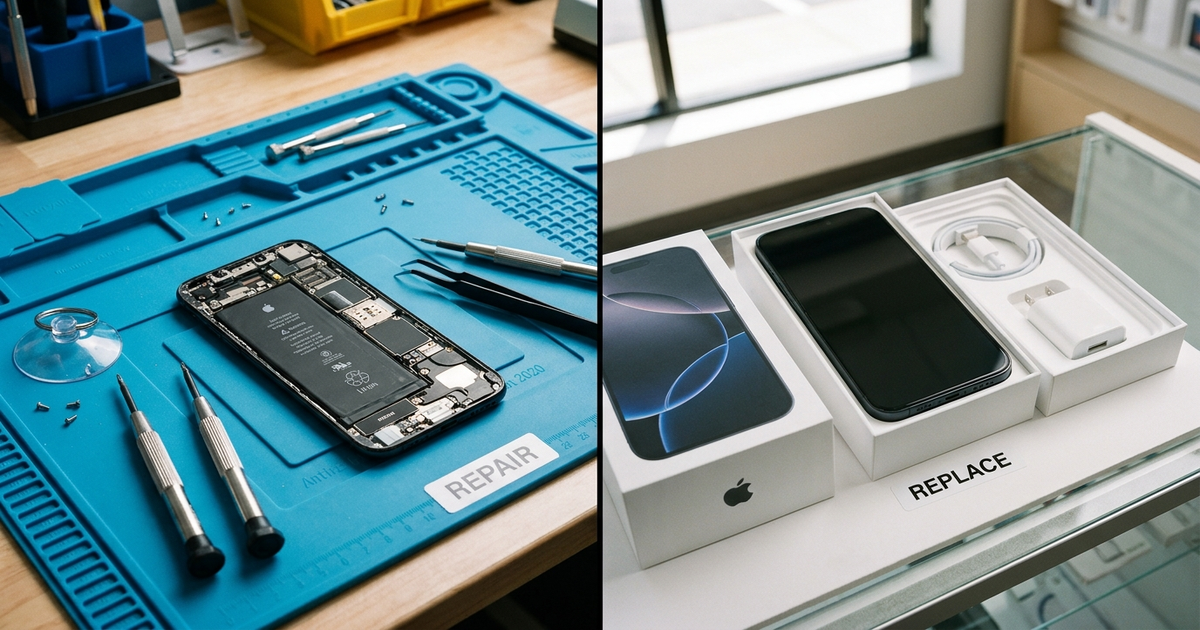
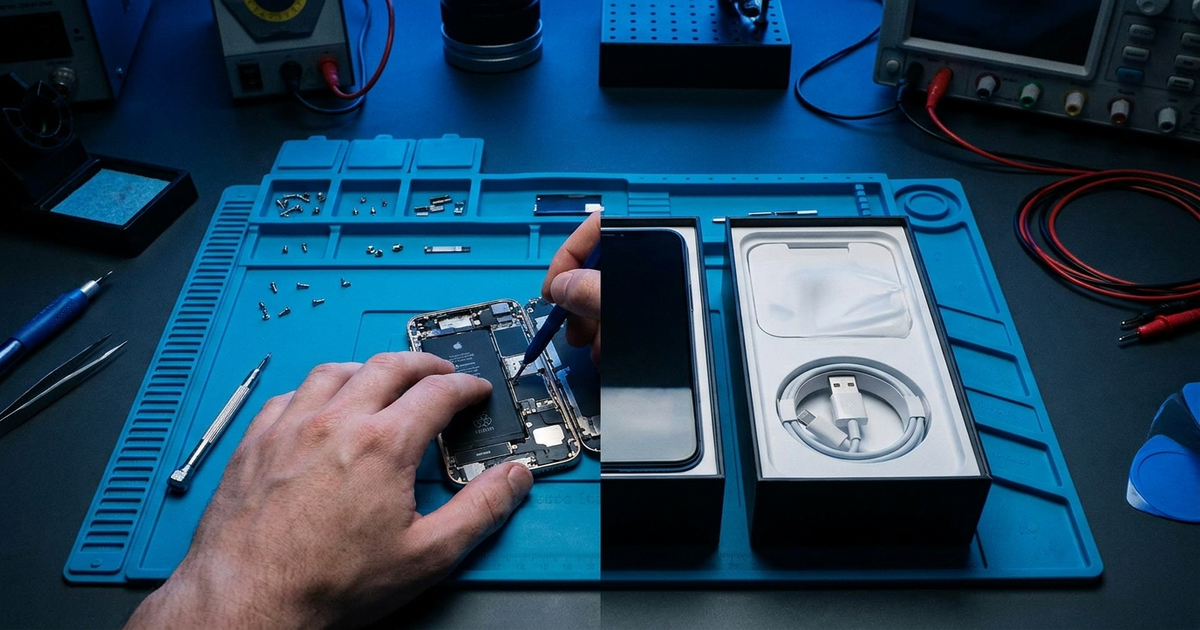
The 50% rule everyone quotes — and what it leaves out
The standard advice, repeated across most repair-cost guides, is some version of: fix it if the repair costs less than half the phone's value, replace it if it costs more. It's a reasonable starting filter, but it treats a phone with three years of security updates left the same as one that's one OS version from end-of-life. A $150 screen repair on a phone that'll keep getting patched until 2029 is a very different bet than the same $150 on a phone whose manufacturer stopped shipping updates last year — even though the cost side of the equation is identical. That gap is why the calculator above weighs update life alongside price instead of treating cost as the only variable.
Is a battery under 80% health a reason to repair or replace?
Repair, almost every time. A battery swap is the cheapest meaningful fix on the board — $49–$119 out of warranty, and often the one repair that doesn't trigger any of the software locks that complicate screen replacements. Degraded battery health shows up as sluggish performance and unexpected shutdowns, which people frequently misread as "the whole phone is dying" when it's actually one part wearing out on schedule. Unless the battery issue is stacked on top of a second, pricier problem, it's rarely the thing that should push you toward a new phone.
Does remaining software support override the cost math?
Past a certain age, yes. Upgrade cycles have stretched considerably — a late-2025 CIRP report found 42% of US iPhone buyers were replacing a phone they'd owned for three-plus years, up from 32% the year before, and the global average replacement cycle now sits around 3.5 years. That trend only holds up because manufacturers are extending update support to match, so the real question isn't "how much does the repair cost" but "how many more years of security patches am I actually buying with this fix." A phone with two years of updates left and a cheap repair is a better hold than a phone with six months left and the same repair bill, regardless of what the price tag says on its own.
Repair vs replace, by symptom
| Symptom | Typical repair cost | Usual verdict |
|---|---|---|
| Cracked screen only | $79–$399 | Repair, unless the phone is already past its update window |
| Battery health under 80% | $49–$119 | Repair — cheapest fix, rarely a reason alone to replace |
| Security updates already ended | Any | Replace — no repair buys back update life |
| Water/liquid damage | Varies, often diagnostic-dependent | Get a firm quote before committing — costs can spiral past replacement |
| Second major repair within a year | Stacks on the first bill | Replace — recurring failures usually point to the whole unit aging out |
Samsung and Android: is repair ever rational when the quote is this close to a new phone?
This is the loudest complaint in forum threads on the topic, and it's a fair one — flagship Android screen repairs have crept close enough to a new-phone price that the math genuinely gets uncomfortable. We broke down the actual 2026 numbers, official and third-party, in our iPhone and Galaxy screen-repair pricing guide, and the honest read is: when a third-party quote lands within striking distance of a refurbished previous-generation phone, you're no longer really choosing "fixed vs broken" — you're choosing between a repaired current phone and an unbroken older one. That's worth running through the calculator above before you book anything.
DIY, shop, or manufacturer — and the parts-pairing catch
Apple opened iPhone 17 self-service repair within six weeks of launch, a record turnaround, though non-professionals still have to rent Apple's tools for around $49. The bigger shift is regulatory: Colorado's anti-parts-pairing law took effect in January 2026 and applies retroactively to devices made from 2021 onward, with Oregon's version following in 2027 — both aimed at the software locks that disable a genuine replacement part unless the manufacturer authorizes it. French authorities are separately investigating Apple's part-pairing as a deceptive practice. Advocates credit exactly this pressure for Apple loosening its repair policy recently. Practically: a shop or DIY kit can save money on a screen or battery, but check whether the specific repair you need is one that triggers a pairing warning before you commit — that's the detail that turns a cheap fix into a phone missing features like True Tone or Face ID until it's re-paired through the manufacturer's own tool.
As CNN's Clare Duffy frames it opening this episode of Terms of Service: "Repairing our tech instead of just replacing it can feel intimidating, but for our environment and for our pocketbook, it could be worth a try." She interviews PIRG's right-to-repair director Nathan Proctor on why that intimidation factor, more than cost, is often what actually pushes people to replace instead of repair.
If your score above lands on "replace," it's worth pricing the swap against something other than the newest flagship — our hands-on rankings of this year's best phones cover which current models are actually worth the upgrade rather than just topping a spec sheet.
Frequently asked
My crack is small — do I have to fix it right now?
Not urgently, but a hairline crack spreads under pressure and moisture can work into it over time, especially once the water-resistant seal around the display is compromised. Treat it as a "fix within a few weeks" problem, not an emergency, unless it's already affecting touch response.
What hidden costs come with "just buying a new phone" instead?
A new case and screen protector ($40–$80), replacement cables if you're switching ecosystems ($20–$50), and two years of AppleCare+ or Samsung Care+ ($240–$408) all narrow the gap in repair's favor once you add them up — most repair-vs-replace comparisons leave them out entirely.
Should I wait for the EU's 2027 replaceable-battery rules?
Only if you're outside a hard deadline. From February 2027, every phone sold in the EU must have a battery a regular person can remove with a standard screwdriver, plus a point-of-sale A–E repairability label. That mostly affects future purchases, not a phone you need fixed today — but if your current phone is on the edge of the "replace" verdict and you can hold out, buying into that generation later gets you an easier repair on the next round too.
Sources: Reviews.org — EU replaceable-battery mandate · PIRG — Failing the Fix 2026 · CNBC — right-to-repair and parts pairing · iDropNews — iPhone 17 self-service repair · iDropNews — iPhone upgrade-cycle data (CIRP)
Updated August 2026
Transparency note: This article was researched and written by Chester Takau with AI assistance for research gathering and drafting. All recommendations reflect the author's own editorial judgment.