How Does AI NPU in Phones Work? The Chip Behind On-Device AI, Explained
Quick answer
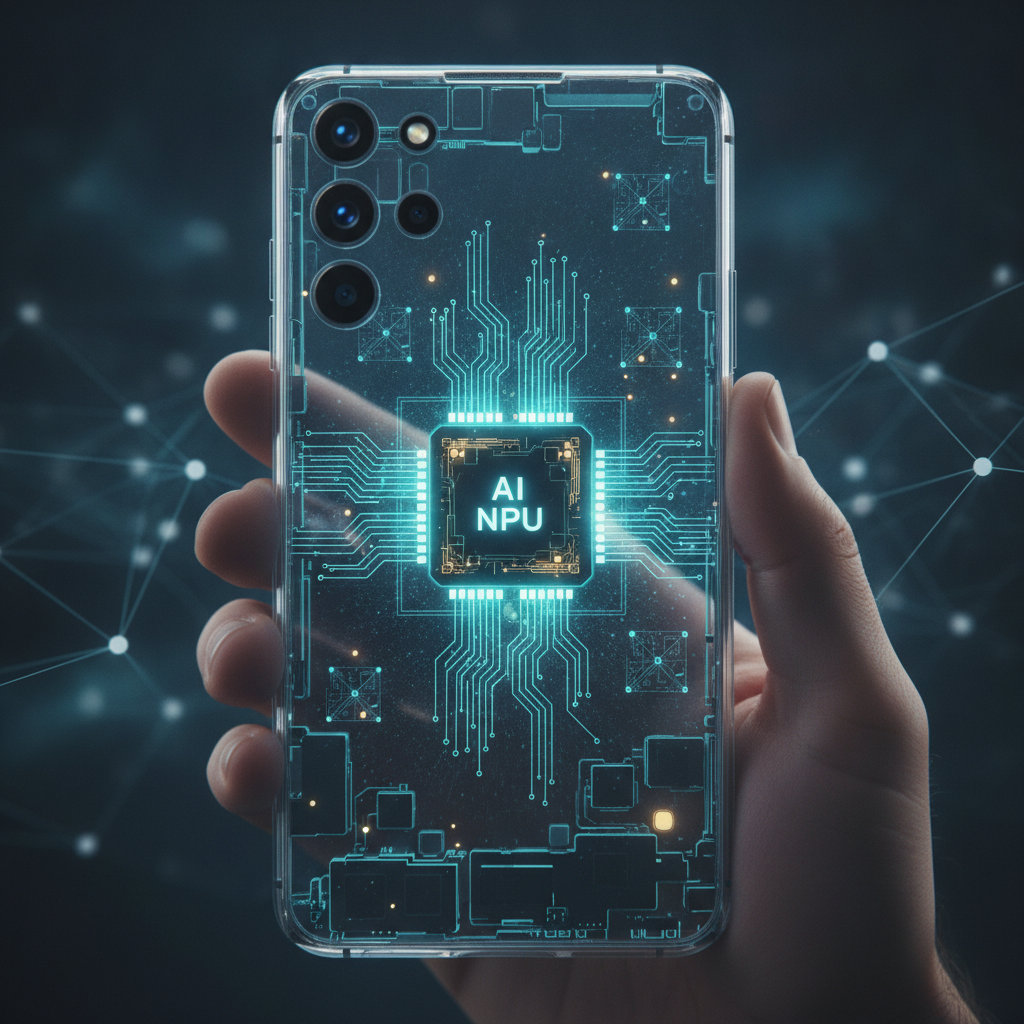
An NPU (neural processing unit) is a dedicated block of silicon inside your phone's main chip, built for one kind of math: the massive parallel multiply-and-add operations that neural networks run on. Instead of a few powerful cores doing work in sequence like a CPU, the NPU pushes model data through thousands of tiny multiply-accumulate (MAC) units at once, using low-precision numbers (INT8 or INT4) to save time and power. When your phone runs night mode, face unlock, live translation, or an on-device model like Gemini Nano, it routes that work to the NPU — which does it faster and with roughly 15–20% less power than the CPU or GPU would.
Every flagship phone shipped in 2026 — Snapdragon 8 Elite Gen 5 devices, Apple's A19 Pro iPhones, Google's Pixel 10 line — carries a dedicated NPU. Yet real-world AI capability still varies wildly between devices, and most owners couldn't say what the chip actually does. Here's the working mechanism, the honest limits, and the marketing traps.
About the author: Chester Takau is an independent tech reviewer who synthesises professional testing data with real user experience to cut through marketing claims. He covers AI tools and gadgets, data-driven tech reviews, and smartphone analysis for AIGadgeTech.
What an NPU actually does inside your phone
A neural network — whether it's denoising a photo or predicting the next word in a sentence — spends almost all of its time on one operation: multiplying huge grids of numbers (matrices) and adding up the results. A single pass through a phone-sized model can mean billions of these multiply-accumulate operations.
An NPU is hardware shaped around that one job. Three design choices define it:
- Parallel MAC arrays. Instead of a handful of general-purpose cores, the NPU packs in grids of simple multiply-accumulate units. Data flows through the array in a rhythm (often called a systolic or dataflow architecture), so thousands of calculations finish per clock tick rather than a few dozen.
- Low-precision math. Phone NPUs mostly compute in 8-bit or 4-bit integers instead of the 32-bit floating point a CPU prefers. Model weights are "quantized" — compressed from 32-bit to 8-bit or 4-bit — which shrinks a model to a quarter of its size and lets the silicon run far more operations per second, at a small, usually invisible accuracy cost.
- Memory kept close. Moving data costs more energy than computing it. NPUs carry large blocks of on-chip SRAM so model weights sit next to the compute units instead of being fetched repeatedly from main RAM.
The practical effect showed up clearly in Qualcomm's own testing of the Snapdragon 8 Elite Gen 5: its Hexagon NPU runs more than 56 AI models in under 5 milliseconds, versus just 13 models at that speed on the same chip's CPU. Same silicon package, same power budget — four times the throughput, purely because the hardware matches the math.
What's the actual difference between the NPU, CPU, and GPU?
A fair question people ask is why the GPU — already a parallel processor — can't just handle AI tasks. It can, and sometimes does. It's just slower per watt for this specific workload. Here's how the three compare on a modern phone chip:
| CPU | GPU | NPU | |
|---|---|---|---|
| Built for | General tasks, logic, branching code | Graphics and parallel floating-point math | Neural network inference only |
| Core layout | A few powerful cores | Hundreds of shader cores | Thousands of tiny MAC units in a dataflow array |
| Preferred math | High-precision (FP32/FP64) | Floating point (FP16/FP32) | Quantized integers (INT8/INT4) |
| Power on an AI task | Highest | High | Lowest — roughly 15–20% less draw |
| Typical phone job | Apps, OS, web browsing | Games, UI rendering, video | Night mode, face unlock, translation, on-device LLMs |
The GPU's weakness for phone AI is precision and plumbing. Its cores are designed for floating-point graphics math and pull data through memory paths built for frames, not model weights. An NPU running quantized INT8 models with weights cached in local SRAM finishes the same job using a fraction of the energy — which is what makes always-on features like wake-word listening feasible at all.
Why do phones brag about "45 TOPS" but apps don't seem to use it?
TOPS — trillions of operations per second — is the headline number every chipmaker slaps on its NPU. It's also close to meaningless for comparing phones, for three reasons:
- The precision problem. A TOPS figure measured at INT4 with sparsity (skipping zero-valued weights) can be double the same chip's number at INT8. Vendors rarely disclose which precision they used, so one brand's "50 TOPS" isn't comparable to another's, as Cybernews documented when developers tried to verify Microsoft's TOPS claims and found no standardized measurement behind them.
- Real workloads use a fraction of peak. TOPS is a theoretical ceiling with perfect data flow. Actual apps hit memory bottlenecks, unsupported operations, and idle cycles.
- Software decides what runs there. An NPU only gets used if the app and OS route work to it. Many "AI" features on phones still run in the cloud or on the CPU regardless of the spec sheet.
The laptop market shows how skewed this gets: 2026 figures put Qualcomm's Snapdragon X2 Elite around 80–85 TOPS and Apple's M5 Neural Engine around 38–40, yet analysts note Apple's machine often handles larger on-device models because of its unified memory, not despite its lower TOPS. The same confusion exists on the PC side, where we broke down AI laptop features like NPUs, TOPS, and Copilot+ in detail. There's an encouraging sign for phones, though: Intel's NPU became the first to get full support in the MLPerf Client standardized benchmark suite, an early step toward apples-to-apples comparisons that phone buyers currently don't have.
Why does Tensor G5 have a dedicated AI chip but still lose to Snapdragon?
Because TOPS and even the NPU itself are only part of the system. Running an on-device language model is memory-bound: to generate each token, the chip must stream the model's entire set of weights from RAM. A 7-billion-parameter model quantized to 4-bit still weighs around 4 GB, so memory bandwidth — not raw compute — caps the speed.
That's exactly where Google's Tensor G5 stumbles. Independent testing shows it running roughly 35% slower than the Snapdragon 8 Elite in multicore work, with its Edge TPU trading blows with — but not clearly beating — Qualcomm's Hexagon NPU, despite Google's AI-first marketing, as Android Authority's comparison and benchmark leaks both show. The NPU is real; the memory system and software stack around it just don't feed it fast enough. For buyers, the lesson is that RAM capacity and bandwidth on the spec sheet predict on-device AI experience better than the NPU's TOPS figure does.
Which features actually route through the NPU?
This is the "so what" test most explainers skip. On a current flagship, the features that genuinely lean on the NPU are the ones that must be fast, continuous, or offline:
- Computational photography — night mode's multi-frame stacking, real-time HDR, and semantic segmentation of scenes (that's how the phone knows a face from a sky).
- Face unlock and fingerprint liveness — inference has to finish in milliseconds, locally, for security.
- Live translation and transcription — offline language packs, Galaxy AI call translation, recorder summaries.
- On-device models — Gemini Nano powering smart replies and summaries, Circle to Search's screen understanding.
- Always-on sensing — wake-word detection and now-playing music recognition, which only sip power because the NPU handles them.
The video above walks through how night photography and offline translation lean on the NPU specifically. What it and most coverage won't tell you is the counterweight: Android Authority's critique that NPUs have been in phones since 2017's Huawei Mate 10 and iPhone X, yet remain locked behind a small, Apple- and Google-curated feature list instead of an open developer platform. The hardware is nine years old; the software that uses it is still catching up.
Does using the NPU drain battery faster than normal use?
Two contradictory claims circulate here, and both are true — they describe different things:
- "AI drains your battery." Enovix battery testing found that running always-on AI features — constant suggestions, photo indexing, ambient listening — can increase drain by up to 50%, per Android Police's reporting.
- "The NPU saves battery." That same testing found offloading AI work to the NPU instead of the CPU or GPU cuts power draw roughly 15–20% for the identical task.
Reconciled: the NPU is the most efficient way to run an AI task; the battery complaints come from how often phones now run those tasks. If your battery life dropped after an AI feature update, the fix isn't avoiding the NPU — it's turning down the frequency of always-on features. The chip itself is the one part of the equation working in your favor.
What's changing with the next generation of phone NPUs
At a preview ahead of the September 22–24, 2026 Snapdragon Summit in Maui, Qualcomm outlined its next Hexagon NPU for the Snapdragon 8 Elite Gen 6 Pro: a transformer-focused "Element Accelerator," 50% more shared memory, and support for Mixture-of-Experts models up to 30 billion parameters, with prefill up to 50% faster on some models, per GSMArena and Android Headlines.
The practical read: a 30B-parameter MoE model on-device means the assistant features that today round-trip to a server — multi-step "agentic" tasks like booking, summarizing across apps, chaining actions — start running locally, instantly, and privately. Expect the same on-device push across the AI gadgets expected at CES 2026, where local inference has become the default pitch.
Will on-device NPUs ever fully replace cloud AI?
Not fully, and not soon. The trajectory is hybrid: privacy-sensitive and latency-critical tasks move on-device (voice, photos, personal context), while heavy reasoning and huge models stay in data centers. The privacy argument is real, though — processing on the NPU means your data never leaves the phone. It's the same local-processing advantage we weigh heavily when ranking the best AI security cameras for 2026, where on-device person detection beats shipping footage to someone else's server. As memory bandwidth grows and 4-bit quantization keeps improving, the "needs the cloud" category shrinks a little each chip generation.
Frequently asked questions
Does my phone actually need an NPU, or is it marketing?
It depends on what you use. If you shoot night-mode photos, use face unlock, translate offline, or run assistant features daily, the NPU is doing real work every day. If your usage is messaging, browsing, and streaming, you won't notice it — yet. The feature list keeps growing toward it, not away.
Can older phones without a modern NPU still run on-device AI?
Yes, with compromises. The CPU or GPU can execute the same models, just slower and hotter, which is why some features on older phones either lag or quietly fall back to cloud processing. Some new features are gated entirely — not because older chips are incapable, but because the experience would be bad enough to hurt the brand.
Is Apple's Neural Engine actually better than Qualcomm's Hexagon NPU?
On paper, no — Qualcomm posts far higher TOPS. In practice it's closer, because Apple's unified memory lets its Neural Engine handle larger models smoothly, and iOS routes more system features through it. The honest answer is that Qualcomm wins the silicon benchmarks while Apple wins on integration; neither gap is decisive for everyday features.
Is a bigger NPU worth paying more for?
Today, only marginally — most NPU features ship across whole flagship tiers regardless. If you're buying a phone to keep for four or five years, prioritize RAM (12 GB or more) over headline TOPS, since memory is the bottleneck for the on-device models arriving next.
Sources
- GSMArena — Snapdragon 8 Elite Gen 6 Pro NPU details (Sept 2026)
- Gizmochina — Snapdragon 8 Elite Gen 5 NPU model-throughput testing
- Cybernews — TOPS marketing vs. standardized MLPerf benchmarks
- Android Police — Enovix AI battery-drain testing
- Android Authority — do phones really need an NPU?
- Android Authority — Tensor G5 vs Snapdragon benchmarks
- LocalAIMaster — 2026 NPU TOPS and memory bandwidth comparison
Updated September 2026.
Transparency note: This article was researched and written by Chester Takau with AI assistance for research gathering and drafting. All recommendations reflect the author's own editorial judgment.