MagSafe vs Qi2 Explained: Same Speed on iPhone 18 Pro, Different Rules Elsewhere
Short answer: MagSafe is Apple's magnetic charging system, and Qi2 is the open standard built on the same magnet-alignment idea. On a current iPhone they now charge at the same speed. Apple lists the iPhone 18 Pro and 18 Pro Max at up to 25W for both. The catch is the label: plain "Qi2" can still mean 15W, and only a charger marked Qi2 25W (also sold as Qi2.2) reaches 25W. You also need iOS 26 or later and a 30W or larger power adapter. Chargers sold as "MagSafe-compatible" without certification are capped at 7.5W.
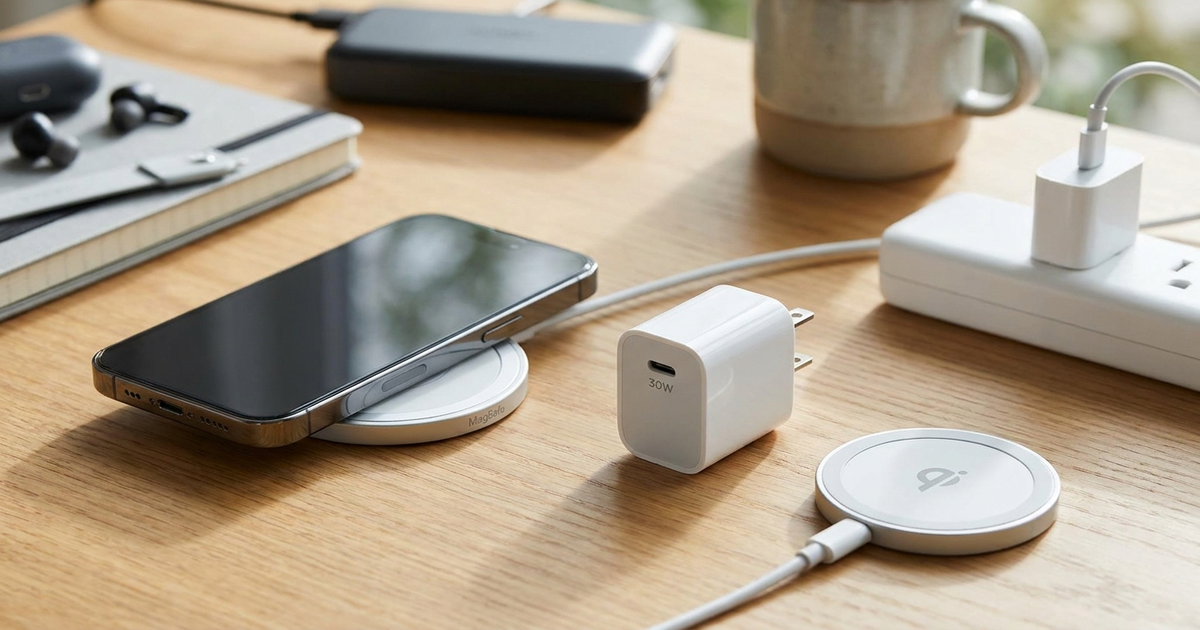
By Chester Takau · Updated November 2026
What wireless speed will you actually get?
The result is the lower of your phone's ceiling and your charger's ceiling. Figures come from the spec pages and tests cited below. Power adapter size is covered in the notes.
Is MagSafe the same thing as Qi2?
Close, but not identical. Both use a ring of magnets to line the phone up with the coil, which cuts the wasted energy and heat of a sloppy placement. MagSafe is Apple's own program, with accessories that need Apple's "Made for MagSafe" licensing. Qi2 is the Wireless Power Consortium's version of the same approach, open to any phone maker and charger brand. Belkin and AppleInsider both make this point in their explainers, and it is why Qi2 chargers usually cost less than official MagSafe gear.
The comparison table
| MagSafe | Qi2 / Qi2.2 | |
|---|---|---|
| Who owns it | Apple | Wireless Power Consortium (open standard) |
| Top speed on iPhone 18 Pro | Up to 25W | Up to 25W |
| Speed to 50% at 15W (Macworld) | About 45 min | About 45 min |
| Speed to 50% at 25W (Macworld, iPhone 16 Pro) | Not separately listed | Roughly 32 to 34 min |
| Phones that work fully | iPhones | iPhones, Pixel 10 and 11 (built-in magnets); Samsung S25 and S26 need a magnetic case |
| Typical price | Higher for official gear | Lower, many brands |
| Direction of compatibility | Android Qi2 phones are not fully compatible with Apple's MagSafe ecosystem (Tom's Guide) | iPhones work fully on Qi2 chargers |
Compiled from Apple's iPhone 18 Pro spec page, Macworld's tests and the sources listed at the bottom.
Why does my iPhone charge at 15W on a "Qi2" charger?
Because "Qi2" alone does not promise 25W. The 25W tier has several names that all describe the same thing: Qi2.2, Qi2 25W and Qi v2.2.1. Engadget and Android Central both called the rename confusing when the WPC launched it. A buyer reads "Qi2" on a box, assumes the fastest tier, and gets 15W.
The naming decoder
| Label on the box | What it means |
|---|---|
| Qi2 (no wattage) | Magnetic charging, which can still be 15W. Check for a 25W mark. |
| Qi2.2, Qi2 25W, Qi v2.2.1 | The same 25W standard under different names. |
| Qi2 Ready | The phone supports Qi2 charging but has no built-in magnets. Samsung's S25 and S26 are the main examples, and you need a magnetic case. |
| MagSafe-compatible | Not certified, capped at 7.5W (Macworld). |
| Made for MagSafe / Qi2 certified | Passed the program's tests, so it can negotiate its rated speed. |
The full chain for 25W
Forum threads on MacRumors and Apple Community show people stuck on this, because every link in the chain has to hold:
- A phone that supports 25W: iPhone 18 Pro and Pro Max do natively. The iPhone 16 series got 25W on Qi2 chargers with iOS 26. The iPhone Air is listed lower at 20W and the 17e at 15W.
- iOS 26 or later for full Qi2 25W, per Macworld.
- A charger certified for Qi2 25W, or Apple's own MagSafe Charger.
- A 30W or larger adapter, according to Apple's support page. A 20W brick may not feed it enough.
- A phone that is not already hot. Chargers and power banks now carry fans or liquid cooling for this reason, such as UGREEN's 25W MagSafe battery bank and AAWireless's new $50 Qi2 car charger with a fan. Independent tests of how much heat cancels the speed gain are thin.
Heat matters for more than speed. Sustained heat is one of the things that wears a battery, so it is worth weighing whether 25W is worth it for a phone you keep for years.
Will my old 15W MagSafe puck still work?
Yes, and it will charge an iPhone 18 Pro at up to 15W. At 15W, Macworld's tests found MagSafe and Qi2 essentially identical: about 45 minutes to 50%, about 90 minutes to 80% and about 115 minutes to 100%. A newer 25W charger took an iPhone 16 Pro to 50% in roughly 32 to 34 minutes. So the upgrade is real but modest, about 12 minutes saved to half charge, and only if the whole chain above is in place.
Qi2 on Samsung and Pixel
This is where the two standards genuinely differ in practice. Pixel 10 and 11 have built-in magnets. Google lists Pixel 11 as Qi2.2-compatible and its Pixelsnap Charger at up to 25W, though Android Authority's reporting suggests 25W may apply only to some models, so treat per-model speeds as unconfirmed.
Samsung is messier. The Galaxy S25 and S26 support Qi2 charging without magnets, and Android Central called the result "incredibly confusing." Samsung's own 25W Qi2 puck needs a Qi2-ready case, as 9to5Google reported in January. A leak from 4 November claims the Galaxy S27 Pro and S27 Ultra may add built-in magnets. That is unconfirmed, so do not buy around it. Accessories like AAWireless Charge ship magnetic ring adapters for "Qi2 Ready" phones in the meantime.
The evidence block: what this article adds
Most explainers still say "both are 15W." The gap this piece fills is a single speed lookup across current phones, plus a decoder for the labels. This is a research synthesis. I have not run my own charge-time tests, and the timing numbers above are Macworld's. Vendor claims are a different matter: Ugreen says its MagFlow Qi2.2 10,000mAh power bank charges an iPhone 18 Pro to about 42% in 30 minutes, but vendor times vary from each other and from lab numbers, so treat them as marketing until independently measured.
9to5Mac's video covers Qi, Qi2, Qi2.2 and MagSafe, and how iOS 26 unlocked 25W on third-party chargers. It was published around the iOS 26 launch, so it predates the iPhone 18 lineup.
What comes next
The WPC has shown prototype work on roughly 50W Qi2, and the possible S27 magnets would close the biggest Android gap. Faster wireless charging also gets more useful as phones run heavier on-device workloads. Phones squeeze AI models into local hardware, and that kind of work leaves less battery headroom. And the same Qi2 25W standard now shows up in pocket travel gear, like Anker's foldable 3-in-1 charger. Wearable owners get the benefit too, since a stand like that also tops up a watch.
FAQ
Do I need Apple's MagSafe Charger for 25W?
No. A third-party charger certified for Qi2 25W gives the same ceiling on supported iPhones, as long as the phone, iOS version and adapter also meet the requirements.
Is a 20W adapter enough for 25W wireless?
Apple says the 25W tier needs a 30W or larger adapter. I found no published figure for how slow a 20W brick runs, so I won't guess one.
Does 25W hurt the battery?
Heat is the concern, and that is why 25W accessories add cooling. I found few independent tests of long-term battery effects, so this remains open.
Did iOS 26 really make my iPhone 16 charge at 25W?
For Qi2 25W chargers, yes. Macworld says full Qi2 25W needs iOS 26 or later, and MacRumors reported that iOS 26 added the 25W support to the iPhone 16 series.
Sources
- Apple: iPhone 18 Pro tech specs
- Apple Support: how to use the MagSafe Charger
- Macworld: Qi2 vs MagSafe test results (updated 2026-10-21)
- Android Central: WPC announces Qi2 25W
- Android Central: Samsung and Qi2 on Android
- 9to5Google: Galaxy S26 Qi2 25W charger (2026-01-28)
- 9to5Google: AAWireless Charge (2026-11-05)
- Gizmochina: Ugreen MagFlow Qi2.2 power bank (2026-11-05)
- SamMobile/Sammyfans: Galaxy S27 Qi2 leak (unconfirmed, 2026-11-04)
- 9to5Mac: UGREEN 25W MagSafe liquid-cooling battery bank (2026-10-17)
- 9to5Mac: Anker foldable 3-in-1 charger (2026-08-31)
- Google Store: Pixelsnap Charger
- Android Authority: Pixel 11 wireless charging
- MacRumors: iOS 26 adds Qi2 25W to iPhone 16 series
- Tom's Guide: What is Qi2
- Belkin: Is MagSafe the same as Qi2?
Updated November 2026.
Transparency note: This article was researched and written by Chester Takau with AI assistance for research gathering and drafting. All recommendations reflect the author's own editorial judgment.