What Is a Smart Ring and How Does It Track Sleep? Sensors, Accuracy and Limits
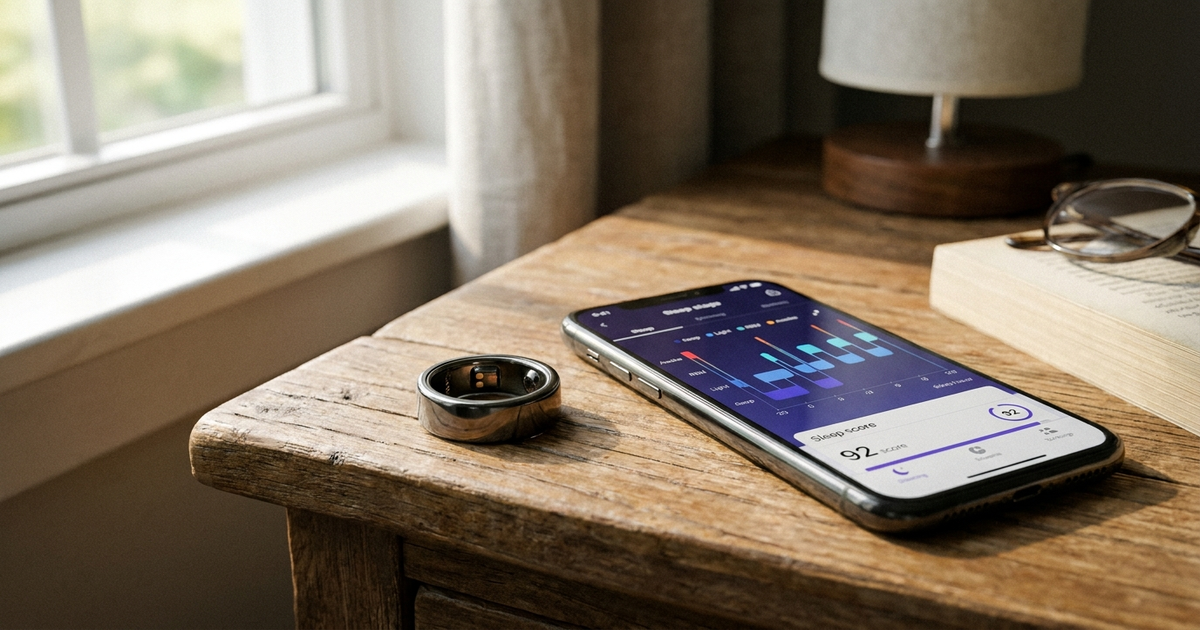
Short answer: a smart ring is a finger-worn health tracker with an optical pulse sensor (PPG), a temperature sensor and a motion sensor. It does not measure brain waves. Overnight it records heart rate, heart rate variability (HRV), breathing rate, skin temperature and movement, and an algorithm estimates when you were asleep and which stage you were in. Oura says its model was trained against lab sleep studies (polysomnography, or PSG). It cites 70–79% agreement on four sleep stages and 90% or better on sleep versus wake in healthy adults.
By Chester Takau · Updated November 2026
How a ring turns signals into sleep stages
A lab sleep study stages sleep from brain activity. A ring has no way to see that, so it works backwards from the body's side effects. Heart rate drops and breathing steadies in deep sleep, and both get more variable in REM. Movement tells it when you are awake. Oura's sleep scientist Raphael Vallat describes the inputs as heart rate, HRV, breathing rate, temperature and motion.
| Signal | Sensor | What it helps the algorithm decide |
|---|---|---|
| Heart rate and HRV | Optical PPG on the finger | Light, deep or REM pattern |
| Breathing rate | Optical PPG and motion | Stage, plus breathing disruptions |
| Skin temperature | Temperature sensor | Nightly trend and baseline |
| Movement | Accelerometer | Asleep versus awake |
| Blood oxygen (some rings) | Optical sensor | Breathing-related dips overnight |
Which sensors a ring carries depends on the model. The mapping is a plain-English summary of the vendor descriptions in the sources below, not a published algorithm.
The finger is a good place for the optical sensor. The research behind this piece points to a stronger blood-flow signal there and less motion than at the wrist. Samsung's own how-to video shows the Galaxy Ring doing the same overnight job with heart rate, SpO2 and skin temperature.
How accurate is it, really?
Two numbers get mixed up. Sleep versus wake agreement is 90% or better by Oura's account. Four-stage agreement (awake, light, deep, REM) is 70–79%. Vallat adds a useful yardstick: trained human scorers agree with each other about 83% of the time, and pure chance would give 25%.
The picture is less rosy for some users. A 2025 Scientific Reports study of people with sleep disorders found about 53% four-stage agreement, which Oura disputes, citing ring fit and data exclusions. A 2024 study of 35 adults found Oura Gen3 beat the Apple Watch and Fitbit at four-stage classification, but Oura funded it and an author sits on its advisory board. Long-term users also report that deep sleep readings don't match lab results. Treat stage splits as an estimate, and trust the trend over any single night.
What a ring can't measure
- Brain activity. Stages are inferred, never read directly.
- A diagnosis, in most cases. Samsung's Galaxy Ring began rolling out a sleep apnea feature on November 3, 2026 in the US and South Korea after regulatory clearance. It compares blood-oxygen drops and breathing disruptions across two sleep sessions in a 10-day window and gives a severity grade. Oura Ring 5's breathing irregularity alerts are wellness features, a different category.
- Reliable data from a bad fit. Fingers swell overnight, so size for that. A loose ring can leave gaps or noisy readings, and a flat battery records nothing.
FAQ
Do I need a subscription to see sleep data?
It depends on the brand. Oura requires a membership ($5.99 a month or $69.99 a year) for detailed data, and shows only daily scores without one. Reviewers often point to Samsung Galaxy Ring, RingConn and Amazfit Helio as subscription-free options.
Which finger should I wear it on?
Guides disagree on the best hand. They agree that sizing for overnight swelling matters more.
I am a writer and researcher, not a clinician. This is general information, not medical advice. This article is a research synthesis, not my own sensor testing.
Sources
- Oura: Sleep staging is not guesswork (2026-08-28)
- Android Authority: Galaxy Ring sleep apnea rollout (2026-11-03)
- PubMed: Oura vs Apple Watch vs Fitbit against PSG (2024)
- Samsung: how Galaxy Ring sleep tracking works
- Samsung Care on YouTube: Track and improve your sleep with Samsung Galaxy Ring
- Notebookcheck: Oura defends its subscription paywall
- Best Buy Canada: which finger to wear a smart ring on
Updated November 2026.
Transparency note: This article was researched and written by Chester Takau with AI assistance for research gathering and drafting. All recommendations reflect the author's own editorial judgment.