AGI vs Narrow AI Explained: Why "It Does Everything" Still Isn't General Intelligence
By Chester Takau · July 2026
Narrow AI vs AGI: Side by Side
| Narrow AI (today) | AGI (hypothetical) | |
|---|---|---|
| What it is | Built to do one kind of task well | Reasons, learns & adapts across any domain like a person |
| New tasks | Needs retraining for anything unrelated | Moves a skill to a new context with no retraining |
| Examples | Product recs, self-driving, image generators, today's chatbots | No real-world example exists yet |
| Reliability | Superhuman on benchmarks, unreliable outside them (jagged intelligence) | Consistent across domains, by definition |
| Status in 2026 | Everything you use today | Not achieved; DeepMind scores 10 cognitive abilities |
Narrow AI is a system built to do one kind of task well — recommend a product, drive a car, generate an image — and it can't transfer that skill to something unrelated without retraining. AGI (artificial general intelligence) would be a system that reasons, learns, and adapts across any domain the way a person can, moving a skill from one context to a completely new one with no retraining at all. Every AI product you've used in 2026, including the chatbot that can write code, draft an email, and describe a photo in the same conversation, is still the first kind. It just does narrow tasks well enough, in enough categories bundled together, that it starts to feel general. It isn't.
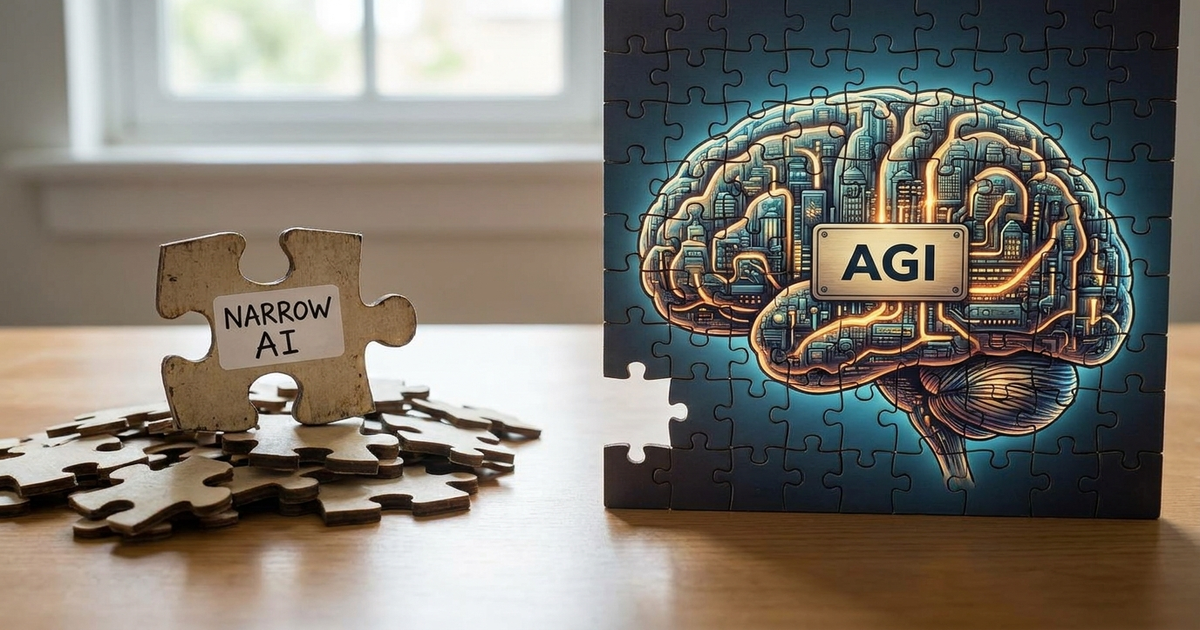
If a model can do so many things, why is it still called "narrow"?
Because doing many things isn't the same as generalizing across them. Stanford's 2026 AI Index put this more bluntly than most research reports do, describing today's frontier models as "superhuman in narrow benchmarked domains and unreliable in others, sometimes within the same conversation." The clearest evidence is what researchers now call jagged intelligence: a model that wins gold-medal-level scores at the International Math Olympiad can still misread a basic analog clock correctly only about 50.1% of the time — barely better than a coin flip. Stack enough narrow skills together and the seams show up as soon as you step outside what the model was actually trained and evaluated on.
Can you just stack narrow AIs together and get AGI?
Not by most definitions, no — and this is where the debate gets genuinely useful rather than just semantic. Google DeepMind's March 2026 paper, "Measuring Progress Toward AGI: A Cognitive Framework," proposes scoring systems against ten separate cognitive abilities — perception, generation, attention, learning, memory, reasoning, metacognition, executive function, problem solving, and social cognition — instead of one pass/fail label. A system can max out generation and reasoning while scoring near zero on metacognition or transfer learning, and bundling ten narrow modules that each cover one ability isn't the same as one system that can shift fluidly between them. DeepMind ran a $200,000 Kaggle hackathon through April 2026 specifically because the five weakest-measured abilities — learning, metacognition, attention, executive function, and social cognition — don't currently have good benchmarks at all, which tells you how far the field still is from a system that reliably has all ten.
How would we actually know when a system crosses into AGI?
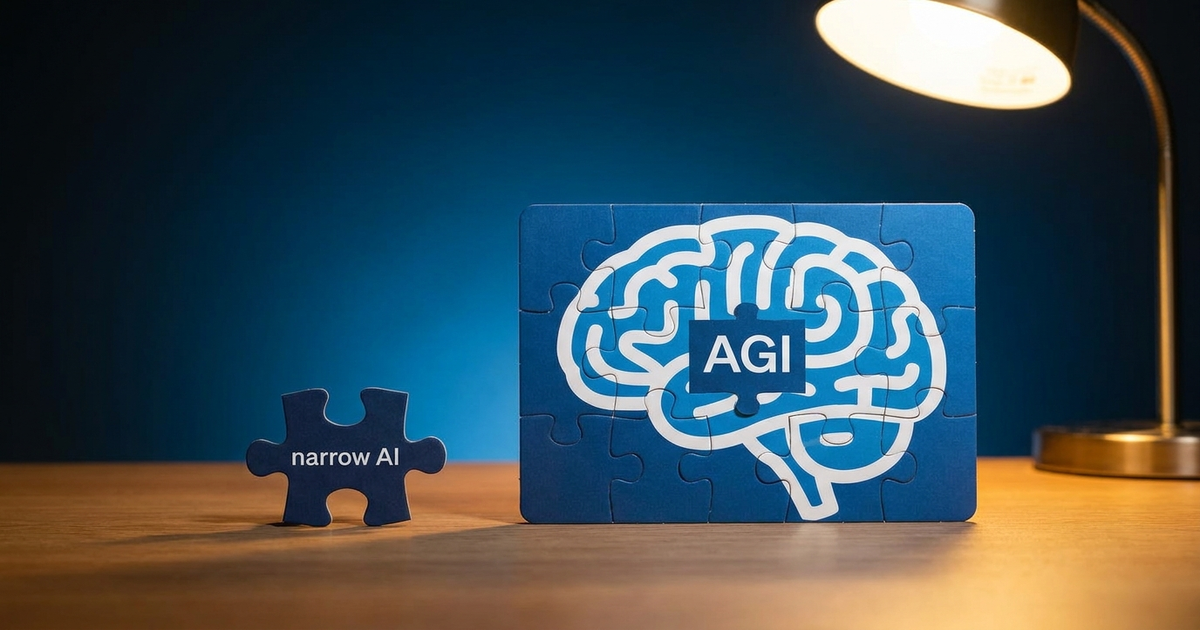
This is exactly what the ARC-AGI benchmark series was built to test, and its results are the strongest argument that we're not close. ARC-AGI puzzles are deliberately designed so a model can't have memorized the answer — each one requires spotting a novel pattern and applying it, the closest a benchmark gets to testing transfer instead of recall. On the earlier ARC-AGI-2 leaderboard, the strongest model (GPT-5.6 Sol) leads at 92.5% versus roughly 66% for an average human — a case where a machine actually beats us. But ARC-AGI-3, which launched March 25, 2026, raised the bar again, and even that same class of frontier model — Gemini 3.1 Pro, the best performer — scored just 0.37%. Capability on one version of a test and near-total failure on a harder version of the same test is what narrow performance looks like when you push past the training distribution.
If you want the three-tier version of this laid out visually — ANI (narrow), AGI (general), and ASI (superintelligence) — the explainer above walks through where current systems actually sit on that ladder, which lines up with the benchmark gap described above rather than the more optimistic marketing version of the story.
Is "AGI" just marketing hype at this point?
Partly, and even people building the systems say so. Sam Altman has called AGI "not a super useful term" precisely because every lab defines it differently, which conveniently lets each lab claim progress against whichever definition suits its funding pitch. The timeline whiplash makes the incentive problem obvious: predicted arrival dates reportedly collapsed by 27 years in six years of forecasting, with Dario Amodei describing near-term arrival and Andrej Karpathy putting it closer to a decade out, using much the same public evidence. A February 2026 academic paper argued today's LLMs already meet some "key tests" for AGI, which reignited the debate rather than settling it — a sign that the term is doing rhetorical work as much as scientific work. None of that means current AI is a gimmick. It means the AGI label itself is being used as a lever, and a healthy amount of skepticism toward any confident date is warranted.
A quick 4-question test you can run on any "AI" product claim
Before you take a company's AGI-adjacent claim at face value, ask: (1) Can it transfer a skill it learned in one context to an unrelated task with no retraining or fine-tuning? (2) Does its performance stay consistent across easy and hard versions of the same type of problem, or does it fall off a cliff like the ARC-AGI-2-to-3 gap above? (3) Is it reasoning about *why* an answer is right, or reciting a pattern it saw in training — the metacognition gap DeepMind's framework flags as one of the weakest-measured abilities today? (4) Would it still work if you changed the format of the question without changing the underlying logic? A narrow system fails at least one of these reliably. Nothing shipping in 2026, including the frontier lab flagships, passes all four consistently — which is really the whole answer to whether AGI is here yet.
Should I actually worry about my job over this?
Worry about narrow AI, not AGI — the risk that's real right now is task automation, not general intelligence replacing judgment wholesale. A self-driving car is narrow AI even though driving feels complex: it's an extremely well-trained system for one domain, not a generalist that could also, say, plan your taxes. The practical version of the jagged-intelligence problem shows up in consumer hardware too, where marketing claims about "AI-powered" devices often overstate what's a narrow feature running on dedicated silicon. If you want to see what actually justifies an "AI" label on a spec sheet versus what's just branding, our guide to the best AI security cameras of 2026 breaks down which detection features are genuinely narrow-AI-driven and which are closer to simple motion sensing with a new name.
The training process underneath every narrow AI system, whether it's a security camera's object detector or a chatbot, is the same core idea — what machine learning actually is and how it learns covers that mechanism in plain terms, and it's worth understanding before any AGI timeline claim will make sense to you. And if you're trying to gauge which "smart" gadgets are worth trusting with narrow-AI claims versus which are overhyped, our smart speaker rankings are a useful real-world comparison of narrow AI done well versus narrow AI dressed up as more than it is.
Transparency note: This article was researched and written by Chester Takau with AI assistance for research gathering and drafting. All recommendations reflect the author's own editorial judgment.