What Is Right to Repair? A Plain-English Explainer for 2026
By Chester Takau · August 2026
Right to repair is the principle — now backed by real law in a growing number of places — that when you buy a device, you should be able to fix it yourself or take it to an independent shop, using genuine parts, official manuals, and diagnostic software, without the manufacturer blocking the repair through software locks or withheld parts. It isn't universal yet. As of January 1, 2026, roughly a quarter of Americans live in a state with an enforceable right-to-repair law covering consumer electronics, and even where a law exists, what it actually guarantees varies a lot by product and by how recently the device shipped.
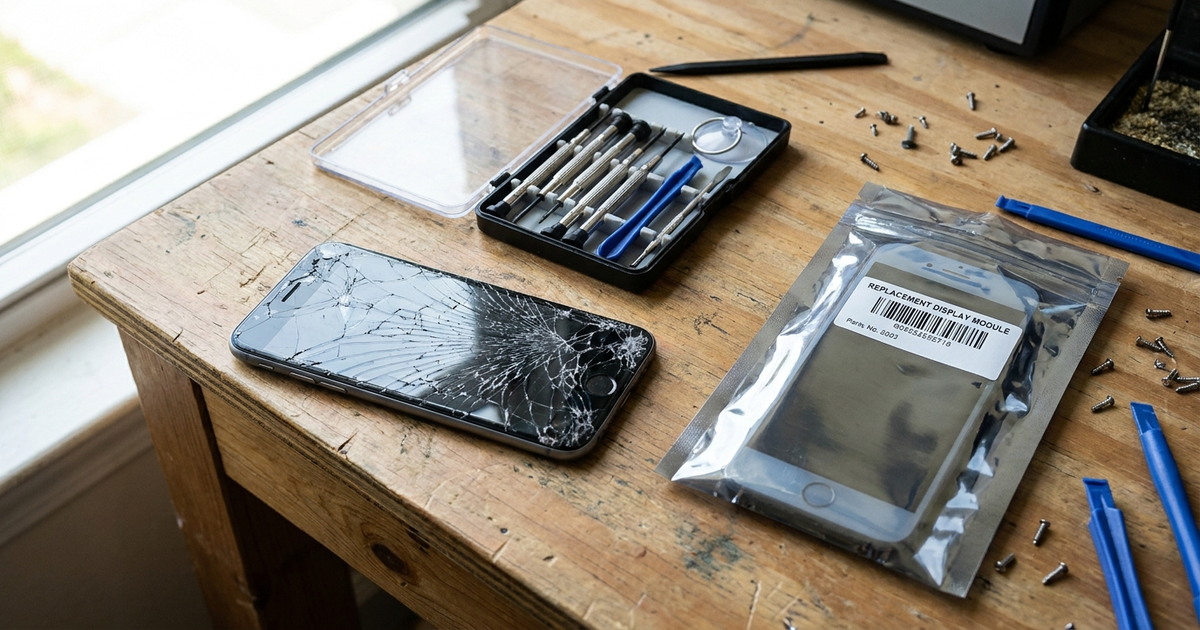
Most right-to-repair coverage online tracks bill numbers and committee votes. What's harder to find is a straight answer to "does this actually change what I can get fixed right now" — so this explainer skips the legislative play-by-play and focuses on parts pairing, warranty myths, and the real gap between a law passing and a law protecting you.
What is "parts pairing," and why does it matter more than the law itself?
Parts pairing is software that ties a specific replacement part to a specific device through a serial number, so the device can tell whether that part is the "authorized" one — even if it's a genuine, functioning component. It's why swapping an iPhone screen or battery outside an authorized channel can trigger a persistent "Unknown Part" warning and quietly disable features like True Tone or accurate battery-health reporting, even though the phone still works. A full breakdown of what current screen swaps actually cost by repair path is in our phone screen repair cost guide. Parts pairing is also the current battleground: the 2026 legislative template advocates are pushing explicitly bans it, arguing that a law requiring manufacturers to sell parts means little if software can still flag or cripple a correctly installed one.
Waveform's explainer above is a clean walkthrough of why phones ended up this hard to fix in the first place, if you want the visual version of this section.
Do you lose your warranty by using an independent repair shop?
Generally no, and this is the most persistent myth in the space. Using a third-party repair shop or genuine third-party part doesn't void the rest of a device's warranty on its own — only the specific work performed there falls outside manufacturer coverage. The EU goes further: under the Right to Repair Directive that became applicable on July 31, 2026, choosing repair over replacement actually extends a consumer's warranty by an additional 12 months. That's a stronger guarantee than anything currently on the books in the US, which is part of why a European reader's phone is, on paper, easier to keep alive than an American one bought the same week.
Which states actually enforce this right now — not just proposed it?
This is the gap most coverage glosses over: a bill "passing" and a law being enforceable are different milestones, often separated by a year or more. Colorado and Washington currently have enforceable consumer-electronics right-to-repair laws, alongside narrower Nevada and Oregon laws covering wheelchairs. Texas's consumer-electronics law is scheduled to take effect in September 2026, and Connecticut added repair provisions through a consumer-protection omnibus bill in July 2026. Meanwhile 33-plus new right-to-repair bills were introduced across 13 states in the first weeks of January 2026 alone, and some version of the legislation has now been introduced in every state — introduced, not enforceable. If your state isn't on the short enforceable list yet, a law existing elsewhere doesn't currently obligate a manufacturer to sell you parts.
Does the John Deere settlement mean anything beyond farm equipment?
On July 8, 2026, the FTC and five states secured a 10-year settlement requiring John Deere to give farmers and independent shops the same repair resources, including software, as its authorized dealers — resolving the antitrust suit the FTC filed in January 2025. It matters beyond tractors because it's a live test of whether "give independent shops the software, not just the parts" holds up as enforceable policy. Worth noting: Deere made similar promises in a 2023 class-action settlement, and right-to-repair advocates were openly skeptical this time that a signed agreement would translate into shops actually getting usable access on the ground.
Are there real downsides to right to repair?
Yes, and they're worth weighing honestly rather than dismissing. Automakers argue that opening telematics data to independent shops creates genuine safety, cybersecurity, and privacy exposure — the Alliance for Automotive Innovation has challenged Massachusetts' auto right-to-repair law on exactly those grounds. There's also a cost-and-carbon counterpoint: repair isn't automatically the greener or cheaper choice once you account for an aging device's efficiency and the labor cost of a complex fix, which is the same trade-off our replace-vs-repair decision framework walks through for phones specifically. And practically: read the actual warranty terms before a DIY repair — "right to repair" describes a growing legal floor, not a guarantee that every manufacturer's fine print already matches it.
Where you live changes how much any of this matters day to day, too. Access to an authorized repair counter is a given in most US cities; it's a very different calculation somewhere remote, which is part of why what actually holds up living in the Pacific Islands leans so heavily on gear that survives without needing a local repair shop at all.
Sources: FTC — Deere settlement press release · European Commission — Right to Repair Directive · PIRG — Americans covered by right to repair · Waste Dive — 2026 right-to-repair bills · Morgan Lewis — 2026 right-to-repair landscape
Updated August 2026
Transparency note: This article was researched and written by Chester Takau with AI assistance for research gathering and drafting. All recommendations reflect the author's own editorial judgment.