Can a Smartwatch Measure Blood Pressure Without a Cuff? What the 2026 Evidence Says
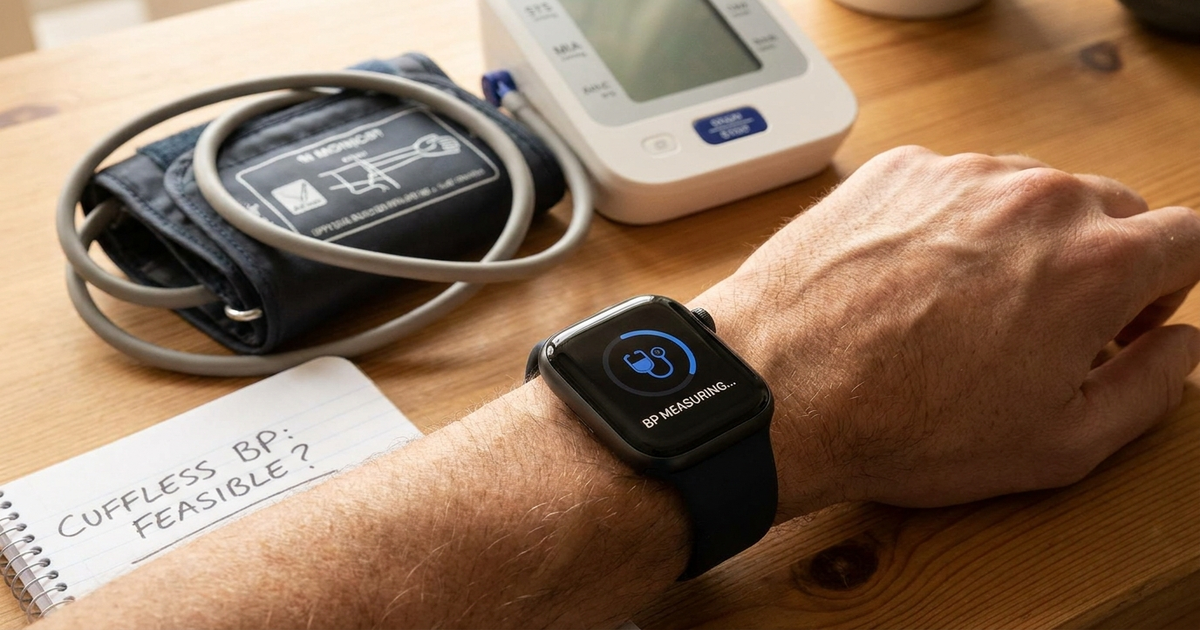
Short answer: not reliably. No smartwatch on sale today has been shown to replace an arm cuff. Samsung's Galaxy Watch shows numbers, but it needs an upper-arm cuff to calibrate it every 28 days. Apple's Watch shows no numbers at all and only flags possible hypertension, and a 2026 JAMA analysis found it misses about 59% of people who have it. Google's November 2026 Nature study screened for hypertension from a watch without a cuff, but it tested one watch model and Google says it does not replace a cuff. The American Heart Association said in December 2025 that cuffless devices "should not be used at this time to diagnose, track or treat high blood pressure."
By Chester Takau · Updated November 2026
Measure, estimate or flag: three different things
"Cuffless" gets used for three quite different products. Sorting them is the quickest way to see what a watch is really doing.
| Group | Example | What you get | Cuff involved? |
|---|---|---|---|
| Estimates numbers | Samsung Galaxy Watch (US, Watch4 and later) | Systolic/diastolic readings on demand | Yes. Upper-arm cuff recalibration every 28 days; needs a Galaxy phone |
| Estimates numbers | Hilo band | Continuous estimates | Yes. Ships with a calibration cuff |
| Flags a pattern | Apple Watch hypertension notifications | An alert only, no numbers | No, but a cuff is the follow-up |
| Research claims of "no calibration" | Utah/UIC wrist bioimpedance prototype | Continuous BP and blood flow in a lab study | Not per user. Prototype, not a product |
The estimating group usually works from pulse-wave timing and shape, which shifts with blood pressure. Since the relationship differs from person to person, the watch has to be anchored to a real cuff reading first. That is why Samsung's "cuffless" feature asks for a cuff, and a forum user's question about whether the watch is "measuring my blood pressure, or just repeating back my last calibration" is a fair one. A 2022 Frontiers study found the Galaxy Watch pulled readings toward its calibration point, overestimating low pressure and underestimating high pressure, and judged its accuracy insufficient.
How accurate are they against a reference device?
Few have been checked independently, and most numbers come from either the maker or small reviewer tests.
- Apple Watch (JAMA analysis, February 2026): 41.2% of people with undiagnosed hypertension got an alert (sensitivity), and 92.3% of people without hypertension correctly got none (specificity).
- Google watch study (Nature, 5 November 2026): 196 participants at 5 US sites, compared with 24-hour ambulatory monitoring. It reached 65.8% sensitivity, 90.0% specificity and 80.6% PPV. Initial office readings reached 55.3% sensitivity. Only one watch model was tested, Alphabet funded the work, and 15 of the 16 authors work for Alphabet.
- Samsung (reviewer test): a Yahoo Tech tester saw the watch read 5–10 points high, for example 124/74 on the watch against 116/71 on the cuff. Forum reports range from within ±3 mmHg to constant offsets or drift.
What the original evidence adds: reading the stats correctly
This is a research synthesis, not my own testing. The point worth pulling out is how often the figures get misread. Cedars-Sinai summarised Apple's feature as "accurate 92% of the time," but 92% is specificity: the share of people without hypertension who correctly got no alert. It says nothing about how often an alert is right, and the 41.2% sensitivity says most people with hypertension never get one.
| Situation | What it means |
|---|---|
| You get an alert | Worth checking with a validated cuff and a clinician. Not a diagnosis. |
| You never get an alert | Not reassurance. About 59% of people with hypertension are never alerted. For adults 60 and older, no alert still leaves about a 34% chance of hypertension. |
Adam Bress, PharmD, of the University of Utah, put the risk this way in an HCPLive interview about the JAMA data:
The companion HCPLive article prints his wording as "The risk there is the idea of being falsely reassured that you don't have hypertension."
Where regulation and guidelines stand
- December 2025: the AHA statement says cuffless devices should not be used to diagnose, track or treat high blood pressure. It also notes FDA clearance does not require testing under a standardised accuracy protocol. A 2025 AHA/ACC guideline reportedly rates cuffless devices "Class 3: No Benefit" for diagnosing or managing hypertension, per a single trade blog.
- January 2026: the FDA issued draft guidance on clinical performance testing for cuffless BP devices. Comments closed 24 March 2026 and it is not final.
- March 2026: Samsung began rolling out on-demand BP in the US, but later told Android Authority the US feature is not intended for medical use.
- June 2026: a University of Utah and UIC team described a wrist bioimpedance prototype in Nature Communications, tested on 150 people including ICU patients. It is not a product and the news summary gives no accuracy figures.
Some newer claims, such as the Vital Signals ring and Huawei's Watch D3, rest on company-commissioned studies or small reviewer tests, so treat them as unverified. A smart ring faces the same limits as a watch; my explainer on how a smart ring tracks sleep covers what finger-worn optical sensors can and cannot read.
FAQ
Does the Apple Watch show my blood pressure numbers?
No. It only sends a "possible hypertension" notification based on pulse-sensor data collected over time.
My Apple Watch said "possible hypertension." What now?
Measure with a validated upper-arm cuff over several days and take the results to a clinician. Houston Methodist has published guidance on how seriously to take these notifications.
Why does my Galaxy Watch need a cuff if it is cuffless?
Because the watch estimates pressure from pulse signals and has to be tied to your own cuff readings first. Recalibrate every 28 days, and compare it against a validated cuff yourself if readings look off.
Can I use a smartwatch if I am on blood pressure medication?
Not as a basis for changing treatment. Apple excludes people already diagnosed with hypertension, and the AHA advises against using these devices to adjust medication. Use a validated cuff and follow your clinician's plan.
Why is the Apple feature unavailable on my watch?
Per Apple Support, it is not offered on the SE or to people under 22, and it excludes pregnant people and those already diagnosed with hypertension.
General information, not medical advice. I am a writer and researcher, not a clinician. Talk to a doctor about your blood pressure.
Sources
- Google Research: detecting signs of hypertension using wearable sensors (2026-11-05)
- American Heart Association: cuffless devices scientific statement (Dec 2025)
- Apple Support: hypertension notifications
- AAFP: smartwatch screening for hypertension
- HCPLive: Adam Bress on false reassurance
- RAPS: FDA draft guidance on cuffless BP devices (Jan 2026)
- Android Authority: limits of Samsung's US BP feature
- SamMobile: Galaxy Watch BP reaches the USA
- Frontiers in Cardiovascular Medicine: Galaxy Watch BP accuracy (2022)
- Yahoo Tech: Samsung Galaxy Watch BP test
- Medical Xpress: wrist bioimpedance prototype (2026-06-01)
- Houston Methodist: how seriously to take smartwatch hypertension notifications
- the5krunner: blood pressure watch accuracy (2026-08-21)
- Cedars-Sinai: can a smartwatch really detect hypertension
Updated November 2026.
Transparency note: This article was researched and written by Chester Takau with AI assistance for research gathering and drafting. All recommendations reflect the author's own editorial judgment.