What Is Battery Health Percentage? What the Number Means and When to Worry
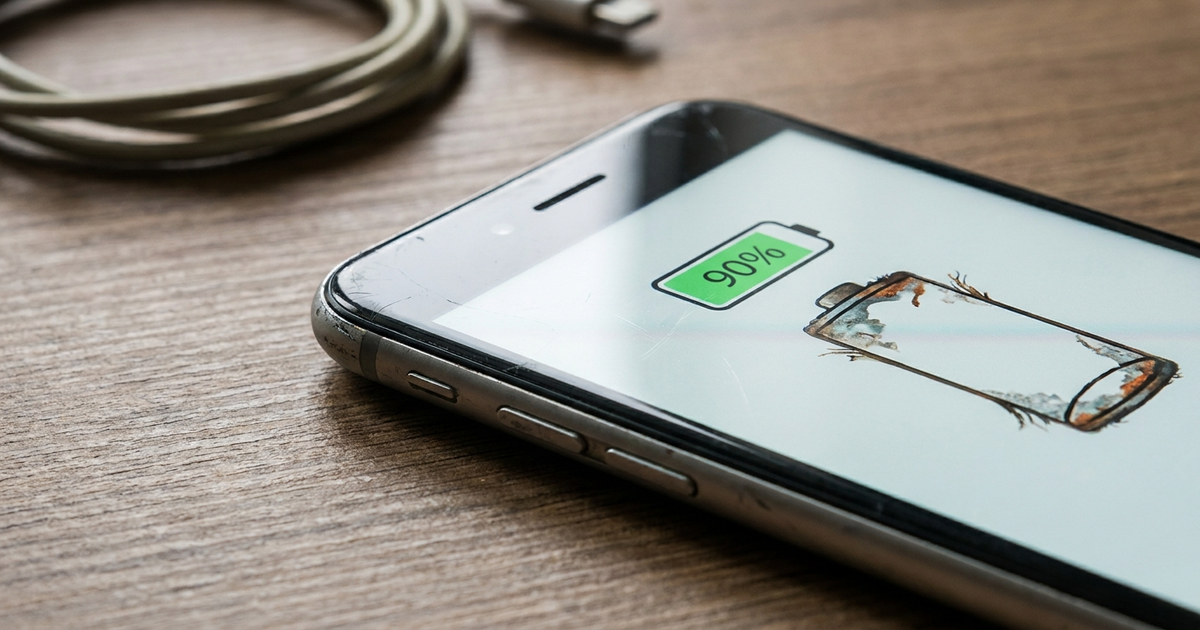
Short answer: battery health percentage is how much charge your battery can hold now compared with when it was new. Apple words it as "Maximum battery capacity measures the device battery capacity relative to when it was new." A phone at 90% can store about nine-tenths of the energy it did on day one. It is not the same as the charge level in the status bar, and it is an estimate, not a direct measurement.
By Chester Takau · Updated November 2026
Battery health versus charge percentage
The charge percentage tells you how full the battery is today. Battery health tells you how big the tank has become. A phone at 100% charge and 85% health is full, but it holds 15% less energy than it did when new, so it runs out sooner. Wear is mostly a function of charge cycles and heat; the fast charging explainer covers how charging power relates to heat.
Why the number is an estimate
A phone can't weigh its own battery. iOS infers Maximum Capacity from voltage, current and temperature, and recalculates it from time to time, according to a July 2026 analysis from Brick. That is why it can go up as well as down, for example from 79% to 81%. Apple Community volunteers say it can fluctuate by up to 5%. The jumps are corrections to the estimate, not the battery recovering.
The same idea applies to other devices. A power bank's label is also a claim about capacity, and a printed figure can sit some distance from what you actually get.
The Wall Street Journal's Joanna Stern looked at fast Maximum Capacity loss on an iPhone 14 Pro in 2023, and linked it to cycle count. The video is old, so use it for the principle, not for current phones. I couldn't verify a transcript, so there's no quote here.
What counts as normal
Apple designs iPhone 14 and earlier to keep 80% at 500 cycles, and iPhone 15 and later to keep 80% at 1,000 complete cycles under ideal conditions. For real-world data, MacRumors ran a three-year test with an 80% charge limit (October 2026): an iPhone 17 Pro Max was at 97% after 12 months and 277 cycles, an iPhone 16 Pro Max at 93% after 24 months and 343 cycles, and an iPhone 15 Pro Max at 88% after 36 months and 369 cycles. There was no phone charged to 100% for comparison, so the effect of the limit can't be isolated.
A common community answer is that a 1% drop within the first months is expected. Brick's rule for when to act: a sustained drop of 2 or more points a month, health below 90% in the first year, or any reading under 80%.
Rated cycles at 80% capacity
| Device | Rated cycles before 80% | Source |
|---|---|---|
| EU minimum for phones and tablets | At least 800 | EU ecodesign rules, in force since 2025-06-20 |
| Pixel 3 to 8 Pro | About 800 | MakeUseOf, 2026-11-03 |
| Pixel 8a and later | 1,000 | MakeUseOf, 2026-11-03 |
| iPhone 15 and later | 1,000 (ideal conditions) | Apple support |
| Most Samsung phones, incl. S26 series | Up to 1,200 | MakeUseOf, 2026-11-03 |
| Galaxy S25 series, A56/A36, Z Fold7/Flip7 | Up to 2,000 | MakeUseOf, 2026-11-03 |
The EU energy label now shows "battery endurance in cycles", so you can compare these figures before you buy. They are manufacturer ratings, not independent tests.
Where to find it, and a catch
iPhones show it under Settings, Battery, Battery Health. Samsung's percentage has been in Settings since One UI 7, but it isn't available everywhere: Android Police found a US Galaxy S24 Ultra on One UI 8.5 doesn't show it, and pulled 99% capacity, a 98% health estimate and about 590 cycles from a hidden dumpstate log. Samsung Members only reports normal, weak or bad. On Windows there is no figure in Settings; run powercfg /batteryreport and divide full charge capacity by design capacity.
The 80% line matters. Users complain that Apple approves battery service only below 80%. If a worn battery is a repair question, the DIY phone repair risks list ranks what can go wrong before you open the case yourself.
What this article adds
This is a research synthesis, not my own testing. The new part is one cross-platform definition, the estimate-versus-measurement explanation, and a single table of rated cycles drawn from regulator, Apple and press figures.
FAQ
Is 99% battery health normal after a month?
Yes, for most people. Brick's analysis of about 1,500 Reddit posts found "100" and "99" were the most-mentioned figures, which points to new-phone anxiety.
Is an 80% charge limit worth it?
The evidence is modest. A German analysis of 102 iPhone 15s found a small but statistically significant benefit, while the MacRumors tester is unsure the trade-off pays off. Some writers argue heat matters more, which is opinion rather than a controlled test.
Do electric car batteries have a health percentage too?
Yes. Ford reports its packs keep more than 90% health on average after 100,000 miles, with about 95% of vehicles holding 87–97% of original capacity (Electrek, 2026-11-09).
Sources
- Apple Support: iPhone battery and performance
- European Commission: new EU rules for smartphones and tablets (2025-06-20)
- MacRumors: three years of 80% charge limits (2026-10-06)
- MakeUseOf: Samsung and Google battery lifespan gap (2026-11-03)
- Android Police: Galaxy S24 Ultra battery health in a hidden log (2026-10-14)
- Brick: new iPhone battery health below 100% (2026-07-24)
- Notebookcheck: is the 80% iPhone charge limit worth it
- Apple Community: is 89% capacity normal after two months
- Electrek: Ford EV batteries retain over 90% health (2026-11-09)
Updated November 2026.
Transparency note: This article was researched and written by Chester Takau with AI assistance for research gathering and drafting. All recommendations reflect the author's own editorial judgment.