What Is Computational Photography? How Software Builds Your Photo, and Where It Starts Inventing
By Chester Takau · Updated November 2026
Computational photography is the use of software, not only optics, to produce a photo. Instead of recording one exposure, the camera captures several frames, then merges, aligns and tone-maps them into a single image. That is how a small phone sensor manages night mode, HDR and portrait blur. The line worth knowing is between merging frames the sensor really captured and generating detail it never saw. Both get called computational photography, and they are not the same thing.
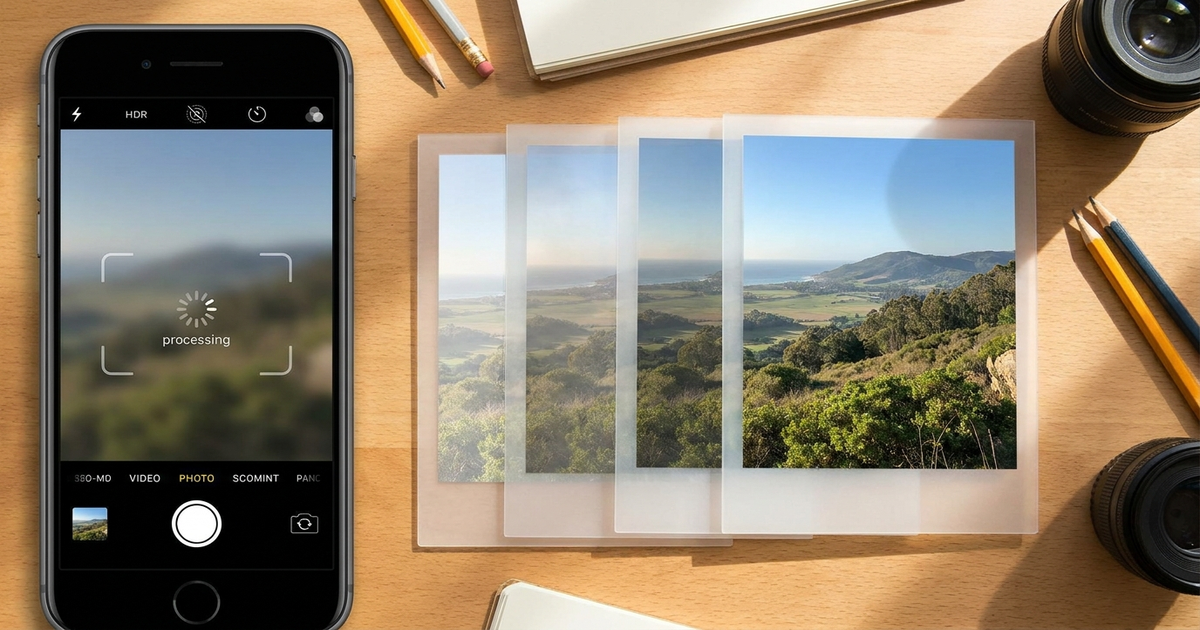
How it works, in five stages
Photographer Vernon Chalmers' June 2026 explainer describes a five-stage pipeline: scene recognition, multi-frame capture, processing, AI enhancement and rendering. Phone makers rarely publish their exact steps, so treat this as the general shape. For a phone-specific walkthrough, see how AI camera modes work on your phone.
It is no longer phone-only. Chalmers says Canon, Sony, Nikon and Fujifilm are adopting AI subject autofocus, pixel-shift and AI noise reduction. In a November 2026 conversation, OM System executives Setsuya Kataoka and Eiji Shirota called computational photography a major part of the company's strategy, citing High-Res Shot as a way to offset the limits of smaller sensors (PhotoRumors).
Enhancing vs. generating: a simple spectrum
Most explainers stop at "software improves photos." This framework sorts features by whether the result depends on data the sensor actually recorded.
| Feature | Where the detail comes from | Category |
|---|---|---|
| Multi-frame HDR, night mode, noise reduction | Several real frames combined | Enhancing |
| Pixel-shift, High-Res Shot | Real frames from shifted sensor positions | Enhancing |
| Diffusion-based zoom (Pixel 10 Pro "Pro Res Zoom") | An on-device model rebuilds detail at up to 100x | Generating |
The edge case is Samsung's moon photos. A 2023 r/Android post argued the phone was adding detail, and Samsung said it does not overlay stored images. Critics, including the Halide app team, argue that adding detail that was not in the scene is not computational photography at all. The same argument now applies to Pixel 10 Pro Res Zoom.
Why some photos look worse
Processing built for hard scenes can over-cook easy ones. Marques Brownlee's May 2026 video argues that the multi-frame HDR and tone mapping phones need in tough light leave ordinary daylight shots with haloing and flat contrast.
As Marques Brownlee puts it near the end of the video:
"So it's all about knowing when to turn it up and when to turn it down. If you need all that stuff to save a bad situation, then turn it up. But if you don't need it, turn it down."
FAQ
Is computational photography the same as editing?
No. It happens during capture and produces the image you first see, while editing changes a finished photo. Commenters on GSMArena still debate where the line sits.
Can I turn it off?
Partly. Some phones let you reduce processing, and apps that skip it exist, but multi-frame merging is built into the normal pipeline. Shooting RAW or using a low-processing app is the usual route.
Does an AI label prove a photo is fake?
No. Pixel 10 photos carry C2PA content credentials that label AI edits, but Android Authority showed the data can be stripped with one exiftool command, so a missing label proves little.
Sources
- Wikipedia: Computational photography
- Vernon Chalmers: Computational photography explained (2026-06)
- PhotoRumors: OM System full-frame interview (2026-11-04)
- Marques Brownlee: Why New Smartphone Cameras Feel Worse (2026-05-11)
- PetaPixel: Samsung explains its moon photos (2023-03-15)
- PhoneArena: Pixel 10 Pro Res Zoom
- Android Authority: Pixel 10 AI watermark removal
Updated November 2026.
Transparency note: This article was researched and written by Chester Takau with AI assistance for research gathering and drafting. All recommendations reflect the author's own editorial judgment.