What Old Tech Predictions Got Wrong: A 2016–2026 Scorecard and the Pattern Behind the Misses
By Chester Takau · November 2026
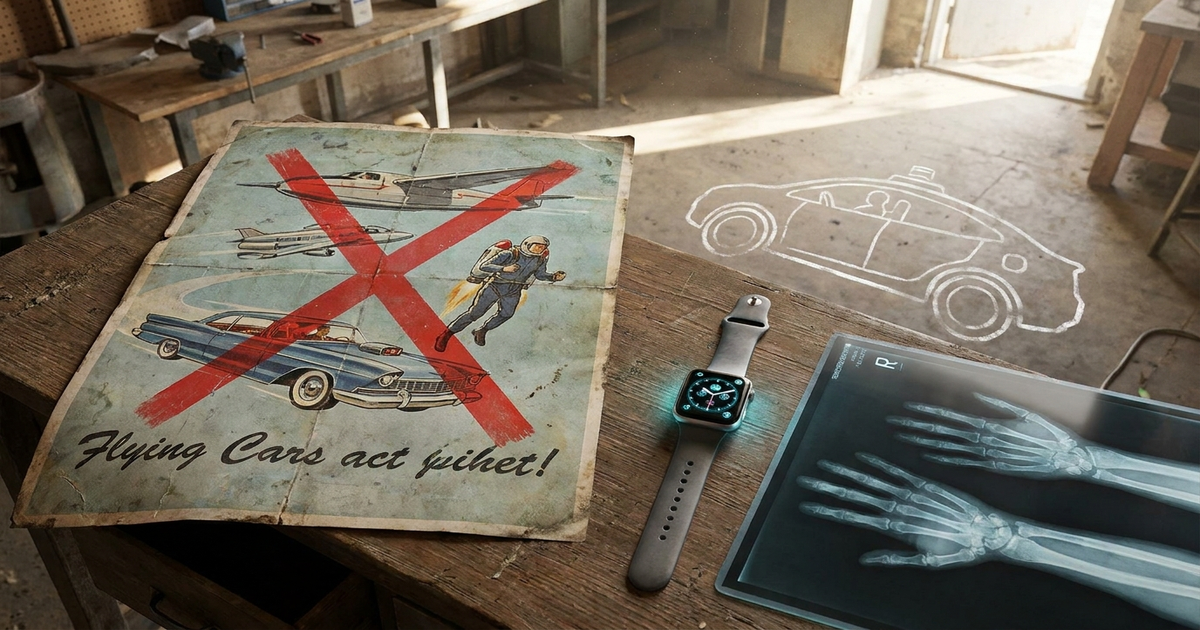
Old tech predictions mostly got the direction right and the timing wrong, and they missed hardest on physical systems. Robotaxis, flying cars, Hyperloop and AR glasses slipped by years or never arrived. Software, phones and AI often arrived early or bigger than forecast. The clearest recent case is radiology: in 2016 Geoffrey Hinton said the world should stop training radiologists, yet a decade later their numbers are up about 10%, according to Fortune.
What did the 2016–2026 forecasts get wrong?
Three self-graded report cards came out in 2026. Futurist Thomas Frey graded his 72 predictions for 2026 on March 24. VR/AR, telehealth, biometric payments and drone shows came true. Driverless cars came true only in part, because Waymo runs in a handful of cities with no mass adoption. Hyperloop, personal eVTOL transport and an electric Indy 500 missed. His own biggest miss was underestimating large language models.
On June 10, LoginRadius CTO Deepak Gupta graded 47 predictions he made in February 2024: 28 right (60%), 9 wrong (19%) and 10 still pending. His misses were Level 4 self-driving as a default option on new cars, robotaxis replacing ridesharing in 10+ US cities, and AR glasses replacing smartphones. His explanation: "the regulatory and insurance bottlenecks were harder than the engineering." Note that these grades are his own.
| Prediction | Who | Outcome |
|---|---|---|
| Stop training radiologists; AI wins in 5–10 years (2016) | Geoffrey Hinton | Missed. Active US radiologists up about 10% |
| Coast-to-coast autonomous Model S drive by end of 2017 | Elon Musk | Missed (per CleanTechnica) |
| Autonomous ride-hailing for "probably half the population of the U.S." by end of 2025 | Elon Musk | Missed (per CleanTechnica) |
| Robotaxis replace ridesharing in 10+ US cities | Deepak Gupta | Missed (self-graded) |
| AR glasses replace smartphones | Deepak Gupta | Missed (self-graded) |
| Hyperloop, personal eVTOL, electric Indy 500 | Thomas Frey | Missed (self-graded) |
| VR/AR, telehealth, biometric payments | Thomas Frey | Came true (self-graded) |
| Generative AI reshaping industries | FTI Consulting | Right (self-graded) |
Why were radiologists the biggest overcorrection?
Fortune's look back (May 4, 2026, republished July 19) gives the numbers. RadBoard.io counted 7,469 open radiology job postings in May 2026, and 1,470 had been open more than 60 days. Medscape put average radiologist pay at $571K in 2025, up 9% year over year. Caseloads rose 25% between 2018 and early 2025, according to JACR. In 2025 Hinton narrowed his claim, saying he had only meant image analysis. He has also said he was "wrong on timing but not the direction." Critics reply that demand moved the opposite way. The lesson for gadget buyers: a tool that makes a job faster can raise demand for the job.
Why do self-driving dates keep slipping?
CleanTechnica (June 14, 2026) lists Musk's misses: a coast-to-coast autonomous Model S drive "by the end of 2017", summoning a car across the country within about two years (a January 2016 tweet), and the 2025 ride-hailing claim made on July 23, 2025. Musk has said, "I tend to be a little optimistic with time frames." CleanTechnica argues the forecasts "have been off for about a decade. And they continue to be off." Gupta's explanation, regulation and insurance, fits: the demo works long before the law, the insurer and the city agree it can run without a driver.
Which tech predictions came true by surprise?
The gadgets that did arrive are mostly small and personal. In the video below, struthless reads old forecasts for 2025 aloud and asks why the present doesn't feel futuristic. One forecast he reads is close to a description of the smartwatch.
"Computers will be strapped to your wrist and incorporate a watch and mobile phone."
A pocket computer replacing the hi-fi stack and the PC is also the arc in the history of the consumer tech hub. Information and communication forecasts held up better than big physical systems, a pattern a 2026 archive comparing past forecasts for 2026 with reality also reports. The Irish Times' 2005 predictions for 2025 fit it: they got the pandemic and hybrid work right and missed home robots. As one Reddit reply put it, "Domestic home robots exist if you count the roomba."
Did Bill Gates really say "640K ought to be enough"?
Probably not. David Pogue at Scientific American writes that the most-quoted bad tech prediction may never have been said. Two others that circulate without context are Ken Olsen's "no reason for any individual to have a computer in his home" and Thomas Watson's "world market for maybe five computers." Treat all three as unverified until you see a primary source. The better-documented embarrassments are different: Metcalfe's 1995 forecast that the internet would collapse in 1996 (after which he ate his column), Ballmer on the iPhone having no chance of significant market share, Gates in 2004 saying spam would be solved in two years, and Alan Sugar in 2005 calling the iPod "dead, finished, gone, kaput."
How can you judge today's AI and gadget hype?
Readers on r/Futurology asked what will "quietly fail despite hype." The top answer, with 468 points, predicts "the vast majority of AI chatbot solutions will also fail," and others named foldables, smart-home devices, 3D TV and blockchain. On r/singularity, commenters say most people still underestimated progress on coding agents, while AGI by 2025 "was never going to happen." Both camps are guessing. The forecasters who graded themselves point to a few checks you can apply:
- Does it need a regulator, insurer or new infrastructure? If yes, add years. This is Gupta's explanation for his misses.
- Is the date from a vendor roadmap? Musk's own words are "a little optimistic with time frames."
- Is it information or physical? Software and communication forecasts held up better than large physical systems.
- Does "replaces the job" ignore demand? The radiology numbers say cheaper analysis can mean more analysis.
- Who grades the forecaster? Frey and Gupta graded themselves, so their scores are generous by construction.
Frequently asked questions
Were the forecasters wrong, or just early?
Both defences exist and are disputed. "Right direction, wrong timing" fits driverless cars, where Waymo operates in a few cities. It fits radiology poorly, because demand rose rather than fell.
What about Kurzweil's scorecards?
Some scorecards claim about 86% accuracy including partial hits. I could not verify that figure, so I left it out of the table.
Sources
- Fortune — radiologists a decade after Hinton's prediction
- CleanTechnica — Elon Musk's missed Full Self-Driving targets, June 14, 2026
- Security Boulevard — Deepak Gupta's scorecard for 47 predictions, June 10, 2026
- Thomas Frey — report card on 72 predictions for 2026, March 24, 2026
- Scientific American (David Pogue) — worst tech predictions and the 640K myth
- Computerworld — tech predictions gone wrong
- FTI Consulting — 2026 outlook, revisiting our tech predictions
Updated November 2026.
Transparency note: This article was researched and written by Chester Takau with AI assistance for research gathering and drafting. All recommendations reflect the author's own editorial judgment.