What Does IP68 Mean on a Phone? The Depth, Time and Fine Print Behind the Label
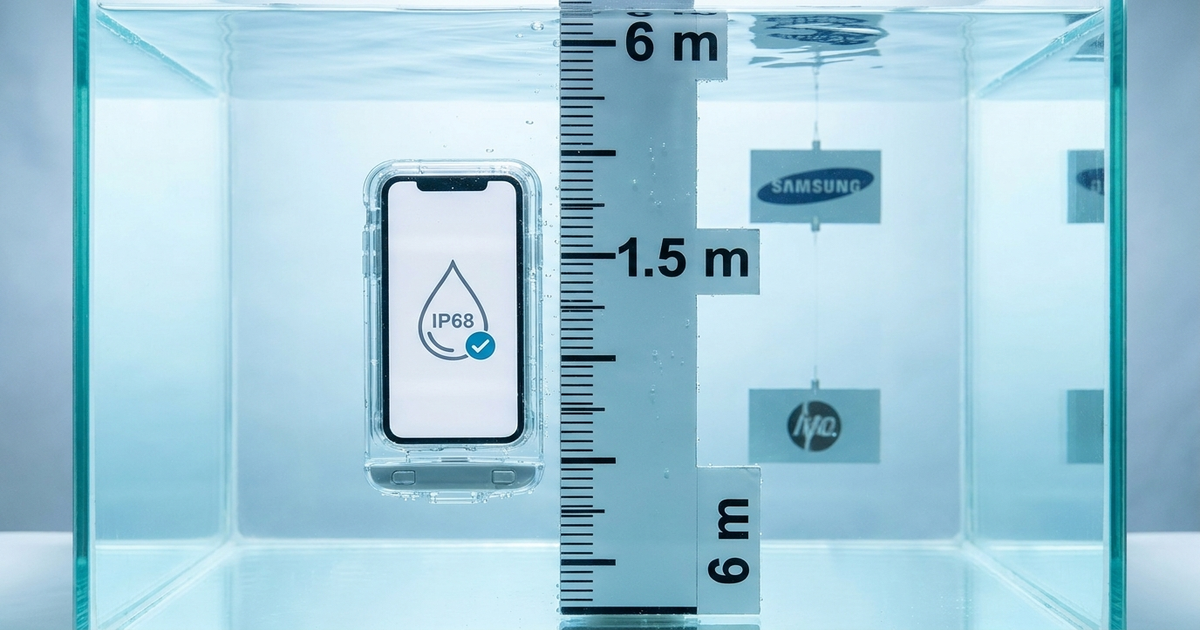
Short answer: IP68 means a phone is dust-tight (the 6) and has passed a test for staying under water longer than a quick dip (the 8). The depth and time for that second test are chosen by the manufacturer, not fixed by the standard. Apple rates the iPhone 18 Pro for 6 metres for up to 30 minutes. Reviewers put the standard Pixel 11 at 1.5 metres for 30 minutes. Both phones carry the same "IP68" label. The test also uses clean, still water and a brand-new phone, so it is a factory snapshot rather than a promise that the phone is waterproof.
By Chester Takau · Updated November 2026
What the two digits stand for
IP stands for "ingress protection", and the code comes from the international standard IEC 60529. Each digit answers a separate question.
- First digit, solids (0–6): a 6 means dust-tight. A 4 only blocks solid objects larger than 1 mm.
- Second digit, water (0–9): an 8 means the device passed a test for continuous submersion. The standard leaves the exact depth and duration to the manufacturer.
Apple's own spec page words it this way: "Rated IP68 (maximum depth of 6 meters up to 30 minutes) under IEC standard 60529." The depth and time sit in brackets because they are Apple's claim, not part of the code.
Pocket-lint's short explainer on the dust and water digits.
Same label, different depths
This is the part most explainers skip. Two phones can both say IP68 while being tested to very different limits. Here are the 2026 figures from the sources I could find.
| Phone | Rating | Stated limit |
|---|---|---|
| iPhone 18 Pro | IP68 | 6 m, up to 30 minutes (Apple) |
| iPhone Duo (foldable) | IP68 | 6 m, up to 30 minutes |
| Pixel 11 (standard) | IP68 | 1.5 m fresh water, 30 minutes (per reviewers) |
| Galaxy Z Fold 8 / Fold 8 Ultra | IP48 | 1.5 m fresh water, 30 minutes; not fully dust-tight |
That is a fourfold gap in depth under one label. Engadget makes the same point about history: newer iPhones are rated for 6 m, older ones for roughly 2–4 m, and all of them are called IP68.
The Fold 8's IP48 matters for a different reason. Its 4 means it is not dust-tight, and SamMobile notes that on a foldable, dust can work its way into the hinge. Apple's iPhone Duo, with a 6, is the first foldable it has rated dust-tight.
What the test does not cover
Engadget's July 2026 piece lists the conditions behind the number: clean, still water and a new device. Heat, salt, chlorine, mud and movement are outside it. Android Central adds that salt and chlorinated water may behave differently on the Fold 8. So the pool, the ocean and a hot shower are not what the rating was measured against.
IP69 is a separate thing. It tests resistance to hot, high-pressure jets and adds no extra protection for submersion. A phone sold as "IP68 and IP69", as with the vivo V80 launch in Pakistan, is not more waterproof underwater than an IP68 phone.
Why the rating fades
Apple's footnote says the tests were done "under controlled laboratory conditions", that resistance is "not [a] permanent condition" and "might decrease as a result of normal wear". Google's help pages go further: water resistance "is not a permanent condition, and diminishes or is lost over time due to normal wear and tear, device repair, disassembly or damage", and the phone meets IPX8 only "when each device leaves the factory".
In practice that means adhesive seals age, drops can open small gaps, and a screen or battery repair may not restore the original seal. If your phone has been opened, treat the rating as gone. My breakdown of DIY phone repair risks covers what opening a phone does to its seals.
Why is water damage not covered by warranty?
This is the most common complaint in the Apple and Samsung community threads: a Galaxy S23 Ultra owner asked how a phone can be sold as IP68 while the warranty excludes water damage. Apple's page says "Liquid damage [is] not covered under warranty", Google says liquid damage voids the warranty, and Engadget reports the same for OnePlus despite its rugged marketing. The rating describes a lab result, and the warranty describes what the company will pay for. Apple's community pages note that local consumer law may still give you rights, so check yours before assuming you are out of luck.
Can I swim with an IP68 phone?
It is a bad bet. Pools bring chlorine and oceans bring salt, neither of which the test uses, and the phone's seals are only as good as its age and repair history. Survival stories exist, such as an r/iPhone user reported by Notebookcheck whose iPhone 15 Pro worked after about 22 hours at roughly 2.5 m in a river. One lucky phone is not a spec. Other owners report damage from rain or a splash.
What to do if an IP68 phone gets wet
Apple advises not charging a phone while it is wet, and many phones show a moisture warning if the port is damp. Dry it, wait, and follow the steps in my guide to what to do first after phone water damage.
What this means when you buy
Read the brand's own number, not the code. Look for the depth and minutes in the spec footnote, check whether the first digit is a 6, and assume the protection starts to decline the day you unbox it. For a drop-in-the-sink phone, any IP68 rating is enough. For anything more, no rating on a spec sheet will pay for the damage.
Sources
- Apple: iPhone 18 Pro tech specs, IP68 wording and footnote
- Engadget: why IP68 can be misleading (2026-07-24)
- SamMobile: iPhone Duo IP68 vs Samsung IP48 foldables (2026-09-11)
- Android Authority: Pixel 11 series launch (2026-08-12)
- Digital Trends: Pixel 11 review
- Android Central: Galaxy Z Fold 8 water resistance (2026-08-12)
- TechSpot: Google explains why Pixel IP68 doesn't last (2025)
- Notebookcheck: iPhone 15 Pro survives 22 hours underwater
- Samsung Community: S23 Ultra water damage thread
Updated November 2026.
Transparency note: This article was researched and written by Chester Takau with AI assistance for research gathering and drafting. All recommendations reflect the author's own editorial judgment.